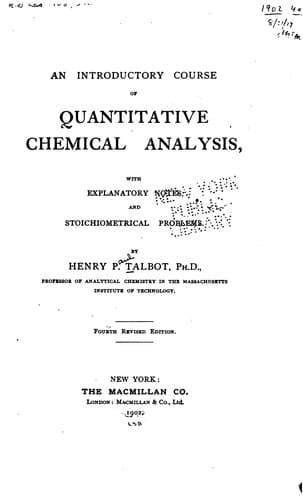
An Introductory Course of Quantitative Chemical Analysis: With Explanatory NotesTalbot, Henry Paul
Science
An Introductory Course of Quantitative Chemical Analysis: With Explanatory Notes
Talbot, Henry Paul
Chemistry, Analytic -- Quantitative
If stationary electrodes are employed, the current strength should be
about 0.1 ampere, which may, after 12 to 15 hours, be increased to 0.2
ampere. The time required for complete deposition is usually from 20
to 24 hours. It is advisable to add 5 cc. of nitric acid (sp. gr. 1.2)
if the electrolysis extends over this length of time. No urea is added
in this case.
When the deposition of the copper appears to be complete, stop the
rotating mechanism and slowly lower the beaker with the left hand,
directing at the same time a stream of water from a wash bottle on
both electrodes. Remove the beaker, shut off the current, and, if
necessary, complete the washing of the electrodes (Note 6). Rinse the
electrodes cautiously with alcohol and heat them in a hot closet until
the alcohol has just evaporated, but no longer, since the copper is
likely to oxidize at the higher temperature. (The alcohol may be
removed by ignition if care is taken to keep the electrodes in motion
in the air so that the copper deposit is not too strongly heated at
any one point.)
Test the solution in the beaker for copper as follows, remembering
that it is to be used for subsequent determinations of iron and zinc:
Remove about 5 cc. and add a slight excess of ammonia. Compare the
mixture with some distilled water, holding both above a white surface.
The solution should not show any tinge of blue. If the presence of
copper is indicated, add the test portion to the main solution,
evaporate the whole to a volume of about 100 cc., and again
electrolyze with clean electrodes (Note 7).
After cooling the electrodes in a desiccator, weigh them and from the
weight of copper on the cathode and of lead dioxide (PbO_{2}) on the
anode, calculate the percentage of copper (Cu) and of lead (Pb) in the
brass.
[Note 1: It is obvious that the brass taken for analysis should be
untarnished, which can be easily assured, when wire is used, by
scouring with emery. If chips or borings are used, they should be well
mixed, and the sample for analysis taken from different parts of the
mixture.]
[Note 2: If a white residue remains upon treatment of the alloy with
nitric acid, it indicates the presence of tin. The material is not,
therefore, a true brass. This may be treated as follows: Evaporate the
solution to dryness, moisten the residue with 5 cc. of dilute nitric
acid (sp. gr. 1.2) and add 50 cc. of hot water. Filter off the
meta-stannic acid, wash, ignite in porcelain and weigh as SnO_{2}.
This oxide is never wholly free from copper and must be purified for
an exact determination. If it does not exceed 2 per cent of the alloy,
the quantity of copper which it contains may usually be neglected.]
[Note 3: The electrodes should be freed from all greasy matter before
using, and those portions upon which the metal will deposit should not
be touched with the fingers after cleaning.]
Public-domain text, read in full here on John Shaqi.
Reviews
Reviews
No reviews yet
Be the first to share your thoughts on this work.
Elsewhere in the archive
Join the Discussion
Join the discussion
Sign in to leave a comment or review.
Sign InorCreate an account