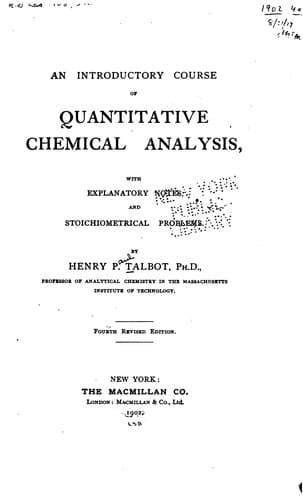
An Introductory Course of Quantitative Chemical Analysis: With Explanatory NotesTalbot, Henry Paul
Science
An Introductory Course of Quantitative Chemical Analysis: With Explanatory Notes
Talbot, Henry Paul
Chemistry, Analytic -- Quantitative
[Note 4: Of the ions in solution, the H^{+}, Cu^{++}, Zn^{++}, and
Fe^{+++} ions tend to move toward the cathode. The NO_{3}^{-} ions and
the lead, probably in the form of PbO_{2}^{--} ions, move toward the
anode. At the cathode the Cu^{++} ions are discharged and plate out as
metallic copper. This alone occurs while the solution is relatively
concentrated. Later on, H^{+} ions are also discharged. In the
presence of considerable quantities of H^{+} ions, as in this acid
solution, no Zn^{++} or Fe^{+++} ions are discharged because of their
greater deposition potentials. At the anode the lead is deposited as
PbO_{2} and oxygen is evolved.
For the reasons stated on page 141 care must be taken that the
solution does not become alkaline if the electrolysis is long
continued.]
[Note 5: Urea reacts with nitrous acid, which may be formed in the
solution as a result of the reducing action of the liberated hydrogen.
Its removal promotes the complete precipitation of the copper. The
reaction is
CO(NH_{2})_{2} + 2HNO_{2} --> CO_{2} + 2N_{2} + 3H_{2}O.]
[Note 6: The electrodes must be washed nearly or quite free from
the nitric acid solution before the circuit is broken to prevent
re-solution of the copper.
If several solutions are connected in the same circuit it is obvious
that some device must be used to close the circuit as soon as the
beaker is removed.]
[Note 7: The electrodes upon which the copper has been deposited
may be cleaned by immersion in warm nitric acid. To remove the lead
dioxide, add a few crystals of oxalic acid to the nitric acid.]
DETERMINATION OF IRON
Most brasses contain small percentages of iron (usually not over 0.1
per cent) which, unless removed, is precipitated as phosphate and
weighed with the zinc.
PROCEDURE.--To the solution from the precipitation of copper and
lead by electrolysis, add dilute ammonia (sp. gr. 0.96) until the
precipitate of zinc hydroxide which first forms re-dissolves, leaving
only a slight red precipitate of ferric hydroxide. Filter off the
iron precipitate, using a washed filter, and wash five times with hot
water. Test a portion of the last washing with a dilute solution of
ammonium sulphide to assure complete removal of the zinc.
The precipitate may then be ignited and weighed as ferric oxide, as
described on page 110.
Calculate the percentage of iron (Fe) in the brass.
DETERMINATION OF ZINC
Public-domain text, read in full here on John Shaqi.
Reviews
Reviews
No reviews yet
Be the first to share your thoughts on this work.
Elsewhere in the archive
Join the Discussion
Join the discussion
Sign in to leave a comment or review.
Sign InorCreate an account