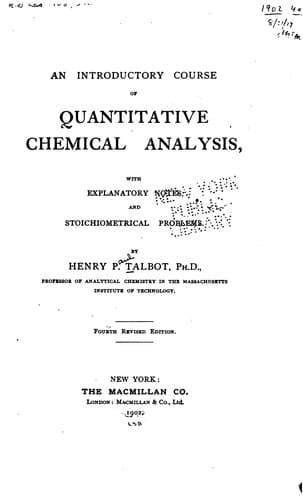
An Introductory Course of Quantitative Chemical Analysis: With Explanatory NotesTalbot, Henry Paul
Science
An Introductory Course of Quantitative Chemical Analysis: With Explanatory Notes
Talbot, Henry Paul
Chemistry, Analytic -- Quantitative
Before using a balance, it is always best to test its adjustment. This
is absolutely necessary if the balance is used by several workers; it
is always a wise precaution under any conditions. For this purpose,
brush off the balance pans with a soft camel's hair brush. Then note
(1) whether the balance is level; (2) that the mechanism for raising
and lowering the beams works smoothly; (3) that the pan-arrests touch
the pans when the beam is lowered; and (4) that the needle swings
equal distances on either side of the zero-point when set in motion
without any load on the pans. If the latter condition is not
fulfilled, the balance should be adjusted by means of the adjusting
screw at the end of the beam unless the variation is not more than one
division on the scale; it is often better to make a proper allowance
for this small zero error than to disturb the balance by an attempt at
correction. Unless a student thoroughly understands the construction
of a balance he should never attempt to make adjustments, but should
apply to the instructor in charge.
The object to be weighed should be placed on the left-hand balance pan
and the weights upon the right-hand pan. Every substance which
could attack the metal of the balance pan should be weighed upon a
watch-glass, and all objects must be dry and cold. A warm body gives
rise to air currents which vitiate the accuracy of the weighing.
The weights should be applied in the order in which they occur in the
weight-box (not at haphazard), beginning with the largest weight which
is apparently required. After a weight has been placed upon the pan
the beam should be lowered upon its knife-edges, and, if necessary,
the pan-arrests depressed. The movement of the pointer will then
indicate whether the weight applied is too great or too small. When
the weight has been ascertained, by the successive addition of small
weights, to the nearest 5 or 10 milligrams, the weighing is completed
by the use of the rider. The correct weight is that which causes the
pointer to swing an equal number of divisions to the right and left
of the zero-point, when the pointer traverses not less than five
divisions on either side.
The balance case should always be closed during the final weighing,
while the rider is being used, to protect the pans from the effect of
air currents.
Before the final determination of an exact weight the beam should
always be lifted from the knife-edges and again lowered into place,
as it frequently happens that the scale pans are, in spite of the
pan-arrests, slightly twisted by the impact of the weights, the beam
being thereby virtually lengthened or shortened. Lifting the beam
restores the proper alignment.
Public-domain text, read in full here on John Shaqi.
Reviews
Reviews
No reviews yet
Be the first to share your thoughts on this work.
Join the Discussion
Join the discussion
Sign in to leave a comment or review.
Sign InorCreate an account