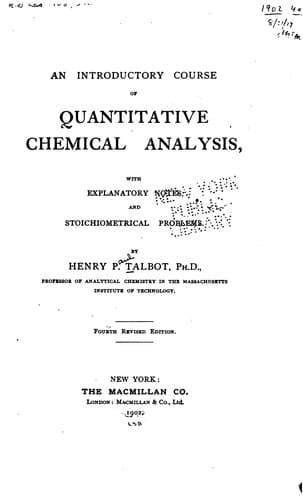
An Introductory Course of Quantitative Chemical Analysis: With Explanatory NotesTalbot, Henry Paul
Science
An Introductory Course of Quantitative Chemical Analysis: With Explanatory Notes
Talbot, Henry Paul
Chemistry, Analytic -- Quantitative
The beam should never be set in motion by lowering it forcibly upon
the knife-edges, nor by touching the pans, but rather by lifting the
rider (unless the balance be provided with some of the newer devices
for the purpose), and the swing should be arrested only when the
needle approaches zero on the scale, otherwise the knife-edges become
dull. For the same reason the beam should never be left upon its
knife-edges, nor should weights be removed from or placed on the
pans without supporting the beam, except in the case of the small
fractional weights.
When the process of weighing has been completed, the weight should
be recorded in the notebook by first noting the vacant spaces in the
weight-box, and then checking the weight by again noting the weights
as they are removed from the pan. This practice will often detect and
avoid errors. It is obvious that the weights should always be returned
to their proper places in the box, and be handled only with pincers.
It should be borne in mind that if the mechanism of a balance is
deranged or if any substance is spilled upon the pans or in the
balance case, the damage should be reported at once. In many instances
serious harm can be averted by prompt action when delay might ruin the
balance.
Samples for analysis are commonly weighed in small tubes with cork
stoppers. Since the stoppers are likely to change in weight from
the varying amounts of moisture absorbed from the atmosphere, it is
necessary to confirm the recorded weight of a tube which has been
unused for some time before weighing out a new portion of substance
from it.
WEIGHTS
The sets of weights commonly used in analytical chemistry range from
20 grams to 5 milligrams. The weights from 20 grams to 1 gram are
usually of brass, lacquered or gold plated. The fractional weights
are of German silver, gold, platinum or aluminium. The rider is of
platinum or aluminium wire.
The sets of weights purchased from reputable dealers are usually
sufficiently accurate for analytical work. It is not necessary that
such a set should be strictly exact in comparison with the absolute
standard of weight, provided they are relatively correct among
themselves, and provided the same set of weights is used in all
weighings made during a given analysis. The analyst should assure
himself that the weights in a set previously unfamiliar to him are
relatively correct by a few simple tests. For example, he should make
sure that in his set two weights of the same denomination (i.e., two
10-gram weights, or the two 100-milligram weights) are actually equal
and interchangeable, or that the 500-milligram weight is equal to
the sum of the 200, 100, 100, 50, 20, 20 and 10-milligram weights
combined, and so on. If discrepancies of more than a few tenths of a
milligram (depending upon the total weight involved) are found, the
weights should be returned for correction. The rider should also be
compared with a 5 or 10-milligram weight.
Public-domain text, read in full here on John Shaqi.
Reviews
Reviews
No reviews yet
Be the first to share your thoughts on this work.
Join the Discussion
Join the discussion
Sign in to leave a comment or review.
Sign InorCreate an account