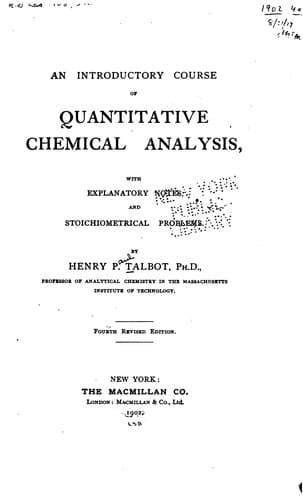
An Introductory Course of Quantitative Chemical Analysis: With Explanatory NotesTalbot, Henry Paul
Science
An Introductory Course of Quantitative Chemical Analysis: With Explanatory Notes
Talbot, Henry Paul
Chemistry, Analytic -- Quantitative
To understand the changes which occur when solids are dissolved where
chemical action is involved, it should be remembered that no substance
is completely insoluble in water, and that those products of a
chemical change which are least dissociated will first form. Consider,
for example, the action of hydrochloric acid upon magnesium hydroxide.
The minute quantity of dissolved hydroxide dissociates thus:
Mg(OH)_{2} <--> Mg^{++} + 2OH^{-}. When the acid is introduced,
the H^{+} ions of the acid unite with the OH^{-} ions to form
undissociated water. The concentration of the OH^{-} ions is thus
diminished, more Mg(OH)_{2} dissociates, the solution is no longer
saturated with the undissociated compound, and more of the solid
dissolves. This process repeats itself with great rapidity until, if
sufficient acid is present, the solid passes completely into solution.
Exactly the same sort of process takes place if calcium oxalate, for
example, is dissolved in hydrochloric acid. The C_{2}O_{4}^{--} ions
unite with the H^{+} ions to form undissociated oxalic acid, the acid
being less dissociated than normally in the presence of the H^{+} ions
from the hydrochloric acid (see statements regarding hydrogen sulphide
above). As the undissociated oxalic acid forms, the concentration of
the C_{2}O_{4}^{--} ions lessens and more CaC_{2}O_{4} dissolves,
as described for the Mg(OH)_{2} above. Numerous instances of the
applications of these principles are given in the Notes.
Water itself is slightly dissociated, and although the resulting H^{+}
and OH^{-} ions are present only in minute concentrations (1 mol. of
dissociated water in 10^{7} liters), yet under some conditions they
may give rise to important consequences. The term !hydrolysis! is
applied to the changes which result from the reaction of these ions.
Any salt which is derived from a weak base or a weak acid (or both)
is subject to hydrolytic action. Potassium cyanide, for example, when
dissolved in water gives an alkaline solution because some of the
H^{+} ions from the water unite with CN^{-} ions to form (HCN), which
is a very weak acid, and is but very slightly dissociated. Potassium
hydroxide, which might form from the OH^{-} ions, is so largely
dissociated that the OH^{-} ions remain as such in the solution. The
union of the H^{+} ions with the CN^{-} ions to form the undissociated
HCN diminishes the concentration of the H^{+} ions, and more water
dissociates (H_{2}O <--> H^{+} + OH^{-}) to restore the equilibrium.
It is clear, however, that there must be a gradual accumulation of
OH^{-} ions in the solution as a result of these changes, causing the
solution to exhibit an alkaline reaction, and also that ultimately the
further dissociation of the water will be checked by the presence of
these ions, just as the dissociation of the H_{2}S was lessened by the
addition of HCl.
Public-domain text, read in full here on John Shaqi.
Reviews
Reviews
No reviews yet
Be the first to share your thoughts on this work.
Elsewhere in the archive
Join the Discussion
Join the discussion
Sign in to leave a comment or review.
Sign InorCreate an account