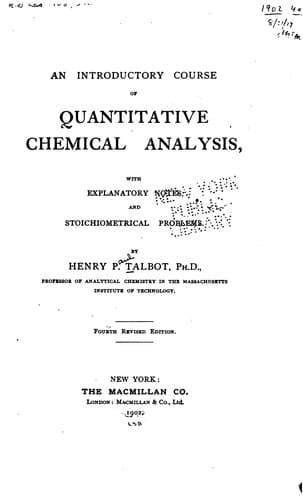
An Introductory Course of Quantitative Chemical Analysis: With Explanatory Notes — John Shaqi
An Introductory Course of Quantitative Chemical Analysis: With Explanatory NotesTalbot, Henry Paul
Science
An Introductory Course of Quantitative Chemical Analysis: With Explanatory Notes
Talbot, Henry Paul
Chemistry, Analytic -- Quantitative
The preparation of a !solution of litmus! which is suitable for use
as an indicator involves the separation from the commercial litmus of
azolithmine, the true coloring principle. Soluble litmus tablets are
often obtainable, but the litmus as commonly supplied to the market is
mixed with calcium carbonate or sulphate and compressed into lumps. To
prepare a solution, these are powdered and treated two or three times
with alcohol, which dissolves out certain constituents which cause a
troublesome intermediate color if not removed. The alcohol is decanted
and drained off, after which the litmus is extracted with hot water
until exhausted. The solution is allowed to settle for some time, the
clear liquid siphoned off, concentrated to one-third its volume and
acetic acid added in slight excess. It is then concentrated to a
sirup, and a large excess of 95 per cent. alcohol added to it. This
precipitates the blue coloring matter, which is filtered off, washed
with alcohol, and finally dissolved in a small volume of water and
diluted until about three drops of the solution added to 50 cc. of
water just produce a distinct color. This solution must be kept in an
unstoppered bottle. It should be protected from dust by a loose plug
of absorbent cotton. If kept in a closed bottle it soon undergoes a
reduction and loses its color, which, however, is often restored by
exposure to the air.
Litmus can be employed successfully with the strong acids and bases,
and also with ammonium hydroxide, although the salts of the latter
influence the indicator unfavorably if present in considerable
concentration. It may be employed with some of the stronger organic
acids, but the use of phenolphthalein is to be preferred.
PREPARATION OF STANDARD SOLUTIONS
!Hydrochloric Acid and Sodium Hydroxide. Approximate Strength!, 0.5 N
PROCEDURE.--Measure out 40 cc. of concentrated, pure hydrochloric
acid into a clean liter bottle, and dilute with distilled water to an
approximate volume of 1000 cc. Shake the solution vigorously for a
full minute to insure uniformity. Be sure that the bottle is not too
full to permit of a thorough mixing, since lack of care at this point
will be the cause of much wasted time (Note 1).
Weigh out, upon a rough balance, 23 grams of sodium hydroxide (Note
2). Dissolve the hydroxide in water in a beaker. Pour the solution
into a liter bottle and dilute, as above, to approximately 1000 cc.
This bottle should preferably have a rubber stopper, as the hydroxide
solution attacks the glass of the ground joint of a glass stopper, and
may cement the stopper to the bottle. Shake the solution as described
above.
[Note 1: The original solutions are prepared of a strength greater
than 0.5 N, as they are more readily diluted than strengthened if
later adjustment is desired.
Public-domain text, read in full here on John Shaqi.
Reviews
Reviews
No reviews yet
Be the first to share your thoughts on this work.
Join the Discussion
Join the discussion
Sign in to leave a comment or review.
Sign InorCreate an account