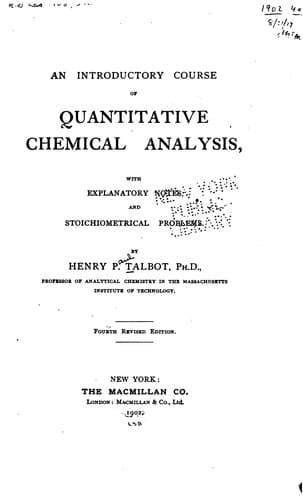
An Introductory Course of Quantitative Chemical Analysis: With Explanatory Notes — John Shaqi
An Introductory Course of Quantitative Chemical Analysis: With Explanatory NotesTalbot, Henry Paul
Science
An Introductory Course of Quantitative Chemical Analysis: With Explanatory Notes
Talbot, Henry Paul
Chemistry, Analytic -- Quantitative
Too much care cannot be taken to insure perfect uniformity of
solutions before standardization, and thoroughness in this respect
will, as stated, often avoid much waste of time. A solution once
thoroughly mixed remains uniform.]
[Note 2: Commercial sodium hydroxide is usually impure and always
contains more or less carbonate; an allowance is therefore made for
this impurity by placing the weight taken at 23 grams per liter. If
the hydroxide is known to be pure, a lesser amount (say 21 grams) will
suffice.]
COMPARISON OF ACID AND ALKALI SOLUTIONS
PROCEDURE.--Rinse a previously calibrated burette three times with the
hydrochloric acid solution, using 10 cc. each time, and allowing the
liquid to run out through the tip to displace all water and air
from that part of the burette. Then fill the burette with the acid
solution. Carry out the same procedure with a second burette, using
the sodium hydroxide solution.
The acid solution may be placed in a plain or in a glass-stoppered
burette as may be more convenient, but the alkaline solution should
never be allowed to remain long in a glass-stoppered burette, as it
tends to cement the stopper to the burette, rendering it useless. It
is preferable to use a plain burette for this solution.
When the burettes are ready for use and all air bubbles displaced from
the tip (see Note 2, page 17) note the exact position of the liquid in
each, and record the readings in the notebook. (Consult page 188.) Run
out from the burette into a beaker about 40 cc. of the acid and add
two drops of a solution of methyl orange; dilute the acid to about
80 cc. and run out alkali solution from the other burette, stirring
constantly, until the pink has given place to a yellow. Wash down the
sides of the beaker with a little distilled water if the solution has
spattered upon them, return the beaker to the acid burette, and add
acid to restore the pink; continue these alternations until the point
is accurately fixed at which a single drop of either solutions served
to produce a distinct change of color. Select as the final end-point
the appearance of the faintest pink tinge which can be recognized, or
the disappearance of this tinge, leaving a pure yellow; but always
titrate to the same point (Note 1). If the titration has occupied more
than the three minutes required for draining the sides of the burette,
the final reading may be taken immediately and recorded in the
notebook.
Public-domain text, read in full here on John Shaqi.
Reviews
Reviews
No reviews yet
Be the first to share your thoughts on this work.
Join the Discussion
Join the discussion
Sign in to leave a comment or review.
Sign InorCreate an account