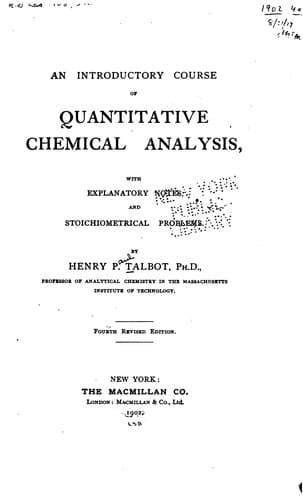
An Introductory Course of Quantitative Chemical Analysis: With Explanatory Notes — John Shaqi
An Introductory Course of Quantitative Chemical Analysis: With Explanatory NotesTalbot, Henry Paul
Science
An Introductory Course of Quantitative Chemical Analysis: With Explanatory Notes
Talbot, Henry Paul
Chemistry, Analytic -- Quantitative
Refill the burettes and repeat the titration. From the records of
calibration already obtained, correct the burette readings and make
corrections for temperature, if necessary. Obtain the ratio of the
sodium hydroxide solution to that of hydrochloric acid by dividing
the number of cubic centimeters of acid used by the number of cubic
centimeters of alkali required for neutralization. The check results
of the two titrations should not vary by more than two parts in one
thousand (Note 2). If the variation in results is greater than this,
refill the burettes and repeat the titration until satisfactory values
are obtained. Use a new page in the notebook for each titration.
Inaccurate values should not be erased or discarded. They should be
retained and marked "correct" or "incorrect," as indicated by the
final outcome of the titrations. This custom should be rigidly
followed in all analytical work.
[Note 1: The end-point should be chosen exactly at the point of
change; any darker tint is unsatisfactory, since it is impossible to
carry shades of color in the memory and to duplicate them from day to
day.]
[Note 2: While variation of two parts in one thousand in the values
obtained by an inexperienced analyst is not excessive, the idea must
be carefully avoided that this is a standard for accurate work to be
!generally applied!. In many cases, after experience is gained, the
allowable error is less than this proportion. In a few cases a
larger variation is permissible, but these are rare and can only
be recognized by an experienced analyst. It is essential that the
beginner should acquire at least the degree of accuracy indicated if
he is to become a successful analyst.]
STANDARDIZATION OF HYDROCHLORIC ACID
SELECTION AND PREPARATION OF STANDARD
The selection of the best substance to be used as a standard for acid
solutions has been the subject of much controversy. The work of Lunge
(!Ztschr. angew. Chem.! (1904), 8, 231), Ferguson (!J. Soc. Chem.
Ind.! (1905), 24, 784), and others, seems to indicate that the best
standard is sodium carbonate prepared from sodium bicarbonate by
heating the latter at temperature between 270° and 300°C. The
bicarbonate is easily prepared in a pure state, and at the
temperatures named the decomposition takes place according to the
equation
2HNaCO_{3} --> Na_{2}CO_{3} + H_{2}O + CO_{2}
and without loss of any carbon dioxide from the sodium carbonate, such
as may occur at higher temperatures. The process is carried out as
described below.
Public-domain text, read in full here on John Shaqi.
Reviews
Reviews
No reviews yet
Be the first to share your thoughts on this work.
Join the Discussion
Join the discussion
Sign in to leave a comment or review.
Sign InorCreate an account