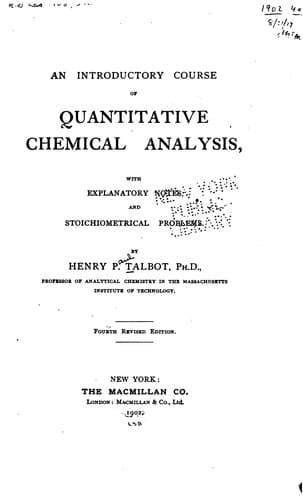
An Introductory Course of Quantitative Chemical Analysis: With Explanatory Notes — John Shaqi
An Introductory Course of Quantitative Chemical Analysis: With Explanatory NotesTalbot, Henry Paul
Science
An Introductory Course of Quantitative Chemical Analysis: With Explanatory Notes
Talbot, Henry Paul
Chemistry, Analytic -- Quantitative
GENERAL DIRECTIONS
Precipitation; Funnels and Filters; Filtration and Washing of
Precipitates; Desiccators; Crucibles and their Preparation
for Use; Ignition of Precipitates
DETERMINATION OF CHLORINE IN SODIUM CHLORIDE
DETERMINATION OF IRON AND OF SULPHUR IN FERROUS AMMONIUM SULPHATE
DETERMINATION OF SULPHUR IN BARIUM SULPHATE
DETERMINATION OF PHOSPHORIC ANHYDRIDE IN APATITE
ANALYSIS OF LIMESTONE
Determination of Moisture; Insoluble Matter and Silica; Ferric
Oxide and Alumina; Calcium; Magnesium; Carbon Dioxide
ANALYSIS OF BRASS
Electrolytic Separations; Determination of Lead, Copper, Iron
and Zinc.
DETERMINATION OF SILICA IN SILICATES
PART IV. STOICHIOMETRY
SOLUTIONS OF TYPICAL PROBLEMS
PROBLEMS
APPENDIX
ELECTROLYTIC DISSOCIATION THEORY
FOLDING OF A FILTER PAPER
SAMPLE NOTEBOOK PAGES
STRENGTH OF REAGENTS
DENSITIES AND VOLUMES OF WATER
CORRECTIONS FOR CHANGE OF TEMPERATURE OF STANDARD SOLUTIONS
ATOMIC WEIGHTS
LOGARITHM TABLES
QUANTITATIVE CHEMICAL ANALYSIS
PART I
INTRODUCTION
SUBDIVISIONS OF ANALYTICAL CHEMISTRY
A complete chemical analysis of a body of unknown composition involves
the recognition of its component parts by the methods of !qualitative
analysis!, and the determination of the proportions in which these
components are present by the processes of !quantitative analysis!.
A preliminary qualitative examination is generally indispensable, if
intelligent and proper provisions are to be made for the separation of
the various constituents under such conditions as will insure accurate
quantitative estimations.
It is assumed that the operations of qualitative analysis are familiar
to the student, who will find that the reactions made use of in
quantitative processes are frequently the same as those employed in
qualitative analyses with respect to both precipitation and systematic
separation from interfering substances; but it should be noted that
the conditions must now be regulated with greater care, and in such
a manner as to insure the most complete separation possible. For
example, in the qualitative detection of sulphates by precipitation
as barium sulphate from acid solution it is not necessary, in most
instances, to take into account the solubility of the sulphate
in hydrochloric acid, while in the quantitative determination of
sulphates by this reaction this solubility becomes an important
consideration. The operations of qualitative analysis are, therefore,
the more accurate the nearer they are made to conform to quantitative
conditions.
Public-domain text, read in full here on John Shaqi.
Reviews
Reviews
No reviews yet
Be the first to share your thoughts on this work.
Join the Discussion
Join the discussion
Sign in to leave a comment or review.
Sign InorCreate an account