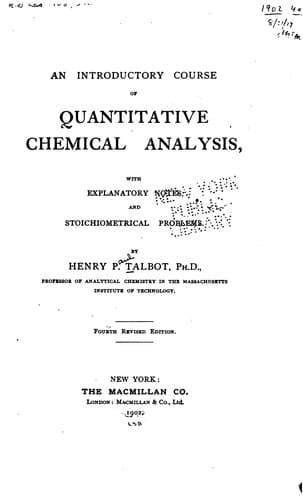
An Introductory Course of Quantitative Chemical Analysis: With Explanatory Notes — John Shaqi
An Introductory Course of Quantitative Chemical Analysis: With Explanatory NotesTalbot, Henry Paul
Science
An Introductory Course of Quantitative Chemical Analysis: With Explanatory Notes
Talbot, Henry Paul
Chemistry, Analytic -- Quantitative
The methods of quantitative analysis are subdivided, according
to their nature, into those of !gravimetric analysis, volumetric
analysis!, and !colorimetric analysis!. In !gravimetric! processes the
constituent to be determined is sometimes isolated in elementary
form, but more commonly in the form of some compound possessing a
well-established and definite composition, which can be readily and
completely separated, and weighed either directly or after ignition.
From the weight of this substance and its known composition, the
amount of the constituent in question is determined.
In !volumetric! analysis, instead of the final weighing of a definite
body, a well-defined reaction is caused to take place, wherein the
reagent is added from an apparatus so designed that the volume of the
solution employed to complete the reaction can be accurately measured.
The strength of this solution (and hence its value for the reaction
in question) is accurately known, and the volume employed serves,
therefore, as a measure of the substance acted upon. An example will
make clear the distinction between these two types of analysis.
The percentage of chlorine in a sample of sodium chloride may be
determined by dissolving a weighed amount of the chloride in water
and precipitating the chloride ions as silver chloride, which is
then separated by filtration, ignited, and weighed (a !gravimetric!
process); or the sodium chloride may be dissolved in water, and a
solution of silver nitrate containing an accurately known amount of
the silver salt in each cubic centimeter may be cautiously added from
a measuring device called a burette until precipitation is complete,
when the amount of chlorine may be calculated from the number of cubic
centimeters of the silver nitrate solution involved in the reaction.
This is a !volumetric! process, and is equivalent to weighing without
the use of a balance.
Volumetric methods are generally more rapid, require less apparatus,
and are frequently capable of greater accuracy than gravimetric
methods. They are particularly useful when many determinations of the
same sort are required.
In !colorimetric! analyses the substance to be determined is converted
into some compound which imparts to its solutions a distinct color,
the intensity of which must vary in direct proportion to the amount of
the compound in the solution. Such solutions are compared with respect
to depth of color with standard solutions containing known amounts of
the colored compound, or of other similar color-producing substance
which has been found acceptable as a color standard. Colorimetric
methods are, in general, restricted to the determinations of very
small quantities, since only in dilute solutions are accurate
comparisons of color possible.
GENERAL DIRECTIONS
Public-domain text, read in full here on John Shaqi.
Reviews
Reviews
No reviews yet
Be the first to share your thoughts on this work.
Join the Discussion
Join the discussion
Sign in to leave a comment or review.
Sign InorCreate an account