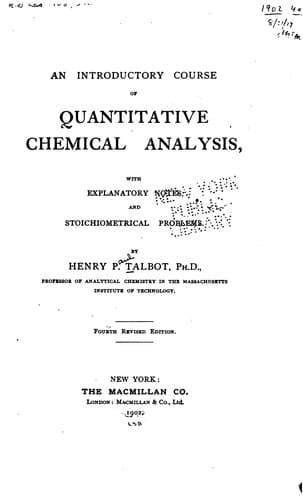
An Introductory Course of Quantitative Chemical Analysis: With Explanatory NotesTalbot, Henry Paul
Science
An Introductory Course of Quantitative Chemical Analysis: With Explanatory Notes
Talbot, Henry Paul
Chemistry, Analytic -- Quantitative
Run out from a burette into a beaker of about 300 cc. capacity nearly
40 cc. of the ferrous solution, add 15 cc. of dilute hydrochloric acid
(sp. gr. 1.12) and 150 cc. of water and run in the bichromate
solution from another burette. Since both solutions are approximately
tenth-normal, 35 cc. of the bichromate solution may be added without
testing. Test at that point by removing a very small drop of the
iron solution on the end of a stirring rod, mixing it with a drop of
indicator on the tile (Note 1). If a blue precipitate appears at once,
0.5 cc. of the bichromate solution may be added before testing again.
The stirring rod which has touched the indicator should be dipped in
distilled water before returning it to the iron solution. As soon as
the blue appears to be less intense, add the bichromate solution in
small portions, finally a single drop at a time, until the point is
reached at which no blue color appears after the lapse of thirty
seconds from the time of mixing solution and indicator. At the close
of the titration a large drop of the iron solution should be taken for
the test. To determine the end-point beyond any question, as soon as
the thirty seconds have elapsed remove another drop of the solution
of the same size as that last taken and mix it with the indicator,
placing it beside the last previous test. If this last previous test
shows a blue tint in comparison with the fresh mixture, the end-point
has not been reached; if no difference can be noted the reaction is
complete. Should the end-point be overstepped, a little more of the
ferrous solution may be added and the end-point definitely fixed.
From the volumes of the solutions used, after applying corrections for
burette readings, and, if need be, for the temperature of solutions,
calculate the value of the ferrous solution in terms of the oxidizing
solution.
[Note 1: The accuracy of the work may be much impaired by the removal
of unnecessarily large quantities of solution for the tests. At the
beginning of the titration, while much ferrous iron is still present,
the end of the stirring rod need only be moist with the solution; but
at the close of the titration drops of considerable size may properly
be taken for the final tests. The stirring rod should be washed to
prevent transfer of indicator to the main solution. This cautious
removal of solution does not seriously affect the accuracy of the
determination, as it will be noted that the volume of the titrated
solution is about 200 cc. and the portions removed are very
small. Moreover, if the procedure is followed as prescribed, the
concentration of unoxidized iron decreases very rapidly as the
titration is carried out so that when the final tests are made, though
large drops may be taken, the amount of ferrous iron is not sufficient
to produce any appreciable error in results.
Public-domain text, read in full here on John Shaqi.
Reviews
Reviews
No reviews yet
Be the first to share your thoughts on this work.
Join the Discussion
Join the discussion
Sign in to leave a comment or review.
Sign InorCreate an account