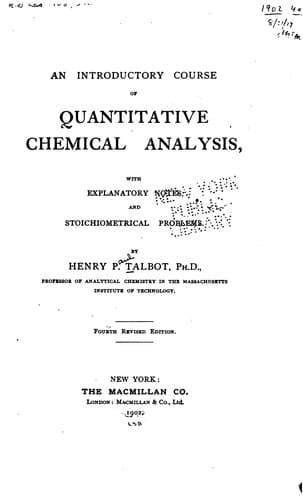
An Introductory Course of Quantitative Chemical Analysis: With Explanatory Notes — John Shaqi
An Introductory Course of Quantitative Chemical Analysis: With Explanatory NotesTalbot, Henry Paul
Science
An Introductory Course of Quantitative Chemical Analysis: With Explanatory Notes
Talbot, Henry Paul
Chemistry, Analytic -- Quantitative
Place 30 cc. of hydrochloric acid (sp. gr. 1.12) in each of two 300
cc. Erlenmeyer flasks, cover them with watch-glasses, and bring the
acid just to boiling. Remove them from the flame and drop in the
portions of wire, taking great care to avoid loss of liquid during
solution. Boil for two or three minutes, keeping the flasks covered
(Note 1), then wash the sides of the flasks and the watch-glass with
a little water and add stannous chloride solution to the hot liquid
!from a dropper! until the solution is colorless, but avoid more than
a drop or two in excess (Note 2). Dilute with 150 cc. of water and
cool !completely!. When cold, add rapidly about 30 cc. of mercuric
chloride solution. Allow the solutions to stand about three minutes
and then titrate without further delay (Note 3), add about 35 cc. of
the standard solution at once and finish the titration as prescribed
above, making use of the ferrous solution if the end-point should be
passed.
From the corrected volumes of the bichromate solution required to
oxidize the iron actually know to be present in the wire, calculate
the relation of the standard solution to the normal.
Repeat the standardization until the results are concordant within at
least two parts in one thousand.
[Note 1: The hydrochloric acid is added to the ferrous solution
to insure the presence of at least sufficient free acid for the
titration, as required by the equation on page 48.
The solution of the wire in hot acid and the short boiling insure the
removal of compounds of hydrogen and carbon which are formed from the
small amount of carbon in the iron. These might be acted upon by the
bichromate if not expelled.]
[Note 2: It is plain that all the iron must be reduced to the ferrous
condition before the titration begins, as some oxidation may have
occurred from the oxygen of the air during solution. It is also
evident that any excess of the agent used to reduce the iron must be
removed; otherwise it will react with the bichromate added later.
The reagents available for the reduction of iron are stannous
chloride, sulphurous acid, sulphureted hydrogen, and zinc; of these
stannous chloride acts most readily, the completion of the reaction
is most easily noted, and the excess of the reagent is most readily
removed. The latter object is accomplished by oxidation to stannic
chloride by means of mercuric chloride added in excess, as the
mercuric salts have no effect upon ferrous iron or the bichromate. The
reactions involved are:
2FeCl_{3} + SnCl_{2} --> 2FeCl_{2} + SnCl_{4}
SnCl_{2} + 2HgCl_{2} --> SnCl_{4} + 2HgCl
The mercurous chloride is precipitated.
It is essential that the solution should be cold and that the stannous
chloride should not be present in great excess, otherwise a secondary
reaction takes place, resulting in the reduction of the mercurous
chloride to metallic mercury:
SnCl_{2} + 2HgCl --> SnCl_{4} + 2Hg.
Public-domain text, read in full here on John Shaqi.
Reviews
Reviews
No reviews yet
Be the first to share your thoughts on this work.
Join the Discussion
Join the discussion
Sign in to leave a comment or review.
Sign InorCreate an account