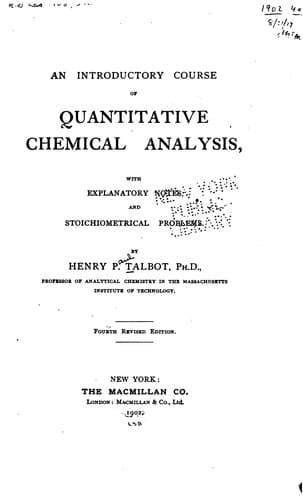
An Introductory Course of Quantitative Chemical Analysis: With Explanatory NotesTalbot, Henry Paul
Science
An Introductory Course of Quantitative Chemical Analysis: With Explanatory Notes
Talbot, Henry Paul
Chemistry, Analytic -- Quantitative
[Note 2: The scouring of the iron crucible is rendered much easier if
it is first heated to bright redness and plunged into cold water. In
this process oily matter is burned off and adhering scale is caused to
chip off when the hot crucible contracts rapidly in the cold water.]
[Note 3: Sodium peroxide must be kept off of balance pans and should
not be weighed out on paper, as is the usual practice in the rough
weighing of chemicals. If paper to which the peroxide is adhering is
exposed to moist air it is likely to take fire as a result of
the absorption of moisture, and consequent evolution of heat and
liberation of oxygen.]
[Note 4: The lamp should never be allowed to remain under the
crucible, as this will raise the temperature to a point at which the
crucible itself is rapidly attacked by the flux and burned through.]
[Note 5: The sodium peroxide acts as both a flux and an oxidizing
agent. The chromic oxide is dissolved by the flux and oxidized to
chromic anhydride (CrO_{3}) which combines with the alkali to form
sodium chromate. The iron is oxidized to ferric oxide.]
[Note 6: The sodium peroxide cannot be used in porcelain, platinum, or
silver crucibles. It attacks iron and nickel as well; but crucibles
made from these metals may be used if care is exercised to keep the
temperature as low as possible. Preference is here given to iron
crucibles, because the resulting ferric hydroxide is more readily
brought into solution than the nickelic oxide from a nickel crucible.
The peroxide must be dry, and must be protected from any admixture of
dust, paper, or of organic matter of any kind, otherwise explosions
may ensue.]
[Note 7: When an iron crucible is employed it is desirable to allow
the fusion to become nearly cold before it is placed in water,
otherwise scales of magnetic iron oxide may separate from the
crucible, which by slowly dissolving in acid form ferrous sulphate,
which reduces the chromate.]
[Note 8: Upon treatment with water the chromate passes into solution,
the ferric hydroxide remains undissolved, and the excess of peroxide
is decomposed with the evolution of oxygen. The subsequent boiling
insures the complete decomposition of the peroxide. Unless this is
complete, hydrogen peroxide is formed when the solution is acidified,
and this reacts with the bichromate, reducing it and introducing a
serious error.]
[Note 9: The addition of the sulphuric acid converts the sodium
chromate to bichromate, which behaves exactly like potassium
bichromate in acid solution.]
[Note 10: If a standard solution of a ferrous salt is not at hand, a
weight of iron wire somewhat in excess of the amount which would be
required if the chromite were pure FeO.Cr_{2}O_{3} may be weighed out
and dissolved in sulphuric acid; after reduction of all the iron by
stannous chloride and the addition of mercuric chloride, this solution
may be poured into the chromate solution and the excess of iron
determined by titration with standard bichromate solution.]
Public-domain text, read in full here on John Shaqi.
Reviews
Reviews
No reviews yet
Be the first to share your thoughts on this work.
Join the Discussion
Join the discussion
Sign in to leave a comment or review.
Sign InorCreate an account