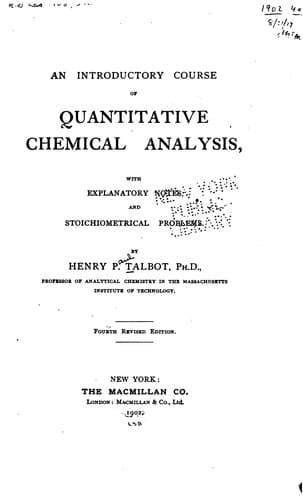
An Introductory Course of Quantitative Chemical Analysis: With Explanatory NotesTalbot, Henry Paul
Science
An Introductory Course of Quantitative Chemical Analysis: With Explanatory Notes
Talbot, Henry Paul
Chemistry, Analytic -- Quantitative
PERMANGANATE PROCESS FOR THE DETERMINATION OF IRON
Potassium permanganate oxidizes ferrous salts in cold, acid solution
promptly and completely to the ferric condition, while in hot acid
solution it also enters into a definite reaction with oxalic acid, by
which the latter is oxidized to carbon dioxide and water.
The reactions involved are these:
10FeSO_{4} + 2KMnO_{4} + 8H_{2}S_{4} --> 5Fe_{2}(SO_{4})_{3} +
K_{2}SO_{4} + 2MnSO_{4} + 8H_{2}O
5C_{2}H_{2}O_{4}(2H_{2}O) + 2KMnO_{4} +3H_{2}SO_{4} --> K_{2}SO_{4} +
2MnSO_{4} + 10CO_{2} + 1 H_{2}O.
These are the fundamental reactions upon which the extensive use of
potassium permanganate depends; but besides iron and oxalic acid the
permanganate enters into reaction with antimony, tin, copper, mercury,
and manganese (the latter only in neutral solution), by which these
metals are changed from a lower to a higher state of oxidation; and it
also reacts with sulphurous acid, sulphureted hydrogen, nitrous acid,
ferrocyanides, and most soluble organic bodies. It should be noted,
however, that very few of these organic compounds react quantitatively
with the permanganate, as is the case with oxalic acid and the
oxalates.
Potassium permanganate is acted upon by hydrochloric acid; the action
is rapid in hot or concentrated solution (particularly in the presence
of iron salts, which appear to act as catalyzers, increasing the
velocity of the reaction), but slow in cold, dilute solutions.
However, the greater solubility of iron compounds in hydrochloric acid
makes it desirable to use this acid as a solvent, and experiments made
with this end in view have shown that in cold, dilute hydrochloric
acid solution, to which considerable quantities of manganous sulphate
and an excess of phosphoric acid have been added, it is possible to
obtain satisfactory results.
It is also possible to replace the hydrochloric acid by evaporating
the solutions with an excess of sulphuric acid until the latter fumes.
This procedure is somewhat more time-consuming, but the end-point of
the permanganate titration is more permanent. Both procedures are
described below.
Potassium permanganate has an intense coloring power, and since the
solution resulting from the oxidation of the iron and the reduction of
the permanganate is colorless, the latter becomes its own indicator.
The slightest excess is indicated with great accuracy by the pink
color of the solution.
PREPARATION OF A STANDARD SOLUTION
!Approximate Strength 0.1 N!
A study of the reactions given above which represent the oxidation of
ferrous compounds by potassium permanganate, shows that there are 2
molecules of KMnO_{4} and 10 molecules of FeSO_{4} on the
left-hand side, and 2 molecules of MnSO_{4} and 5 molecules of
Fe_{2}(SO_{4})_{5} on the right-hand side. Considering only these
compounds, and writing the formulas in such a way as to show the
oxides of the elements in each, the equation becomes:
Public-domain text, read in full here on John Shaqi.
Reviews
Reviews
No reviews yet
Be the first to share your thoughts on this work.
Join the Discussion
Join the discussion
Sign in to leave a comment or review.
Sign InorCreate an account