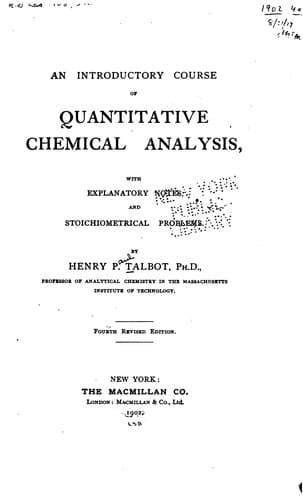
An Introductory Course of Quantitative Chemical Analysis: With Explanatory Notes — John Shaqi
An Introductory Course of Quantitative Chemical Analysis: With Explanatory NotesTalbot, Henry Paul
Science
An Introductory Course of Quantitative Chemical Analysis: With Explanatory Notes
Talbot, Henry Paul
Chemistry, Analytic -- Quantitative
Wash-bottles for distilled water should be made from flasks of about
750 cc. capacity and be provided with gracefully bent tubes, which
should not be too long. The jet should be connected with the tube
entering the wash-bottle by a short piece of rubber tubing in such
a way as to be flexible, and should deliver a stream about one
millimeter in diameter. The neck of the flask may be wound with cord,
or covered with wash-leather, for greater comfort when hot water is
used. It is well to provide several small wash-bottles for liquids
other than distilled water, which should invariably be clearly
labeled.
TRANSFER OF LIQUIDS
Liquids should never be transferred from one vessel to another, nor to
a filter, without the aid of a stirring rod held firmly against the
side or lip of the vessel. When the vessel is provided with a lip it
is not usually necessary to use other means to prevent the loss of
liquid by running down the side; whenever loss seems imminent a !very
thin! layer of vaseline, applied with the finger to the edge of the
vessel, will prevent it. The stirring rod down which the liquid runs
should never be drawn upward in such a way as to allow the solution to
collect on the under side of the rim or lip of a vessel.
The number of transfers of liquids from one vessel to another during
an analysis should be as small as possible to avoid the risk of slight
losses. Each vessel must, of course, be completely washed to insure
the transfer of all material; but it should be remembered that this
can be accomplished better by the use of successive small portions of
wash-water (perhaps 5-10 cc.), if each wash-water is allowed to drain
away for a few seconds, than by the addition of large amounts which
unnecessarily increase the volume of the solutions, causing loss of
time in subsequent filtrations or evaporations.
All stirring rods employed in quantitative analyses should be rounded
at the ends by holding them in the flame of a burner until they begin
to soften. If this is not done, the rods will scratch the inner
surface of beakers, causing them to crack on subsequent heating.
EVAPORATION OF LIQUIDS
Public-domain text, read in full here on John Shaqi.
Reviews
Reviews
No reviews yet
Be the first to share your thoughts on this work.
Join the Discussion
Join the discussion
Sign in to leave a comment or review.
Sign InorCreate an account