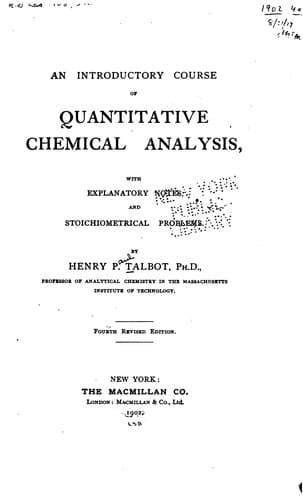
An Introductory Course of Quantitative Chemical Analysis: With Explanatory NotesTalbot, Henry Paul
Science
An Introductory Course of Quantitative Chemical Analysis: With Explanatory Notes
Talbot, Henry Paul
Chemistry, Analytic -- Quantitative
In this connection it must also be emphasized that only the operator
himself can know the whole history of an analysis, and only he can
know whether his work is worthy of full confidence. No work should be
continued for a moment after such confidence is lost, but should
be resolutely discarded as soon as a cause for distrust is fully
established. The student should, however, determine to put forth his
best efforts in each analysis; it is well not to be too ready to
condone failures and to "begin again," as much time is lost in these
fruitless attempts. Nothing less than !absolute integrity! is or can
be demanded of a quantitative analyst, and any disregard of this
principle, however slight, is as fatal to success as lack of chemical
knowledge or inaptitude in manipulation can possibly be.
NOTEBOOKS
Notebooks should contain, beside the record of observations,
descriptive notes. All records of weights should be placed upon the
right-hand page, while that on the left is reserved for the notes,
calculations of factors, or the amount of reagents required.
The neat and systematic arrangement of the records of analyses is
of the first importance, and is an evidence of careful work and an
excellent credential. Of two notebooks in which the results may be,
in fact, of equal value as legal evidence, that one which is neatly
arranged will carry with it greater weight.
All records should be dated, and all observations should be recorded
at once in the notebook. The making of records upon loose paper is a
practice to be deprecated, as is also that of copying original entries
into a second notebook. The student should accustom himself to orderly
entries at the time of observation. Several sample pages of systematic
records are to be found in the Appendix. These are based upon
experience; but other arrangements, if clear and orderly, may prove
equally serviceable. The student is advised to follow the sample pages
until he is in a position to plan out a system of his own.
REAGENTS
The habit of carefully testing reagents, including distilled water,
cannot be too early acquired or too constantly practiced; for, in
spite of all reasonable precautionary measures, inferior chemicals
will occasionally find their way into the stock room, or errors will
be made in filling reagent bottles. The student should remember that
while there may be others who share the responsibility for the purity
of materials in the laboratory of an institution, the responsibility
will later be one which he must individually assume.
The stoppers of reagent bottles should never be laid upon the desk,
unless upon a clean watch-glass or paper. The neck and mouth of all
such bottles should be kept scrupulously clean, and care taken that no
confusion of stoppers occurs.
WASH-BOTTLES
Public-domain text, read in full here on John Shaqi.
Reviews
Reviews
No reviews yet
Be the first to share your thoughts on this work.
Join the Discussion
Join the discussion
Sign in to leave a comment or review.
Sign InorCreate an account