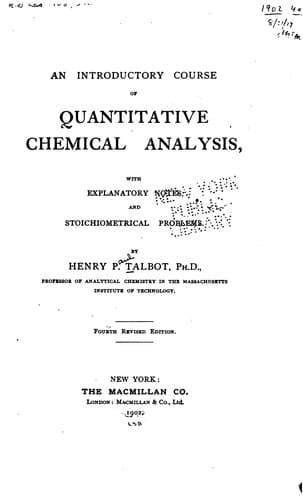
An Introductory Course of Quantitative Chemical Analysis: With Explanatory NotesTalbot, Henry Paul
Science
An Introductory Course of Quantitative Chemical Analysis: With Explanatory Notes
Talbot, Henry Paul
Chemistry, Analytic -- Quantitative
Transfer the moist precipitate to a weighed porcelain or platinum
crucible and ignite, using great care to raise the temperature slowly
while drying the filter in the crucible, and to insure the ready
access of oxygen during the combustion of the filter paper, thus
guarding against a possible reduction of the phosphate, which would
result in disastrous consequences both to the crucible, if of
platinum, and the analysis. Do not raise the temperature above
moderate redness until the precipitate is white. (Keep this precaution
well in mind.) Ignite finally at the highest temperature of the
Tirrill burner, and repeat the heating until the weight is constant.
If the ignited precipitate is persistently discolored by particles of
unburned carbon, moisten the mass with a drop or two of concentrated
nitric acid and heat cautiously, finally igniting strongly. The
acid will dissolve magnesium pyrophosphate from the surface of the
particles of carbon, which will then burn away. Nitric acid also aids
as an oxidizing agent in supplying oxygen for the combustion of the
carbon.
From the weight of magnesium pyrophosphate (Mg_{2}P_{2}O_{7})
obtained, calculate the phosphoric anhydride (P_{2}O_{5}) in the
sample of apatite.
[Note 1: The ionic change involved in the precipitation of the
magnesium compound is
PO_{4}^{---} + NH_{4}^{+} + Mg^{++} --> [MgNH_{4}PO_{4}].
The magnesium ammonium phosphate is readily dissolved by acids, even
those which are no stronger than acetic acid. This is accounted for
by the fact that two of the ions into which phosphoric acid may
dissociate, the HPO_{4}^{--} or H_{2}PO_{4}^{-} ions, exhibit the
characteristics of very weak acids, in that they show almost no
tendency to dissociate further into H^{+} and PO_{4}^{--} ions.
Consequently the ionic changes which occur when the magnesium ammonium
phosphate is brought into contact with an acid may be typified by the
reaction:
H^{+} + Mg^{++} + NH_{4}^{+} + PO_{4}^{---} --> Mg^{++} + NH_{4}^{+} +
HPO_{4}^{--};
that is, the PO_{4}^{--} ions and the H^{+} ions lose their identity
in the formation of the new ion, HPO_{4}^{--}, and this continues
until the magnesium ammonium phosphate is entirely dissolved.]
[Note 2: During ignition the magnesium ammonium phosphate loses
ammonia and water and is converted into magnesium pyrophosphate:
2MgNH_{4}PO_{4} --> Mg_{2}P_{2}O_{7} + 2NH_{3} + H_{2}O.
The precautions mentioned on pages 111 and 123 must be observed with
great care during the ignition of this precipitate. The danger here
lies in a possible reduction of the phosphate by the carbon of the
filter paper, or by the ammonia evolved, which may act as a reducing
agent. The phosphorus then attacks and injures a platinum crucible,
and the determination is valueless.]
ANALYSIS OF LIMESTONE
Public-domain text, read in full here on John Shaqi.
Reviews
Reviews
No reviews yet
Be the first to share your thoughts on this work.
Elsewhere in the archive
Join the Discussion
Join the discussion
Sign in to leave a comment or review.
Sign InorCreate an account