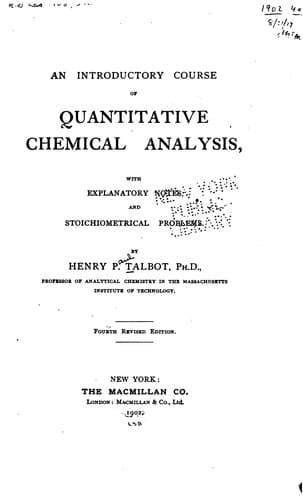
An Introductory Course of Quantitative Chemical Analysis: With Explanatory NotesTalbot, Henry Paul
Science
An Introductory Course of Quantitative Chemical Analysis: With Explanatory Notes
Talbot, Henry Paul
Chemistry, Analytic -- Quantitative
Limestones vary widely in composition from a nearly pure marble
through the dolomitic limestones, containing varying amounts of
magnesium, to the impure varieties, which contain also ferrous and
manganous carbonates and siliceous compounds in variable proportions.
Many other minerals may be inclosed in limestones in small quantities,
and an exact qualitative analysis will often show the presence of
sulphides or sulphates, phosphates, and titanates, and the alkali or
even the heavy metals. No attempt is made in the following procedures
to provide a complete quantitative scheme which would take into
account all of these constituents. Such a scheme for a complete
analysis of a limestone may be found in Bulletin No. 700 of the United
States Geological Survey. It is assumed that, for these practice
determinations, a limestone is selected which contains only the more
common constituents first enumerated above.
DETERMINATION OF MOISTURE
The determination of the amount of moisture in minerals or ores is
often of great importance. Ores which have been exposed to the weather
during shipment may have absorbed enough moisture to appreciably
affect the results of analysis. Since it is essential that the seller
and buyer should make their analyses upon comparable material, it is
customary for each analyst to determine the moisture in the sample
examined, and then to calculate the percentages of the various
constituents with reference to a sample dried in the air, or at a
temperature a little above 100°C., which, unless the ore has undergone
chemical change because of the wetting, should be the same before and
after shipment.
PROCEDURE.--Spread 25 grams of the powdered sample on a weighed
watch-glass; weigh to the nearest 10 milligrams only and heat at
105°C.; weigh at intervals of an hour, after cooling in a desiccator,
until the loss of weight after an hour's heating does not exceed
10 milligrams. It should be noted that a variation in weight of 10
milligrams in a total weight of 25 grams is no greater relatively than
a variation of 0.1 milligram when the sample taken weighs 0.25 gram
DETERMINATION OF THE INSOLUBLE MATTER AND SILICA
Public-domain text, read in full here on John Shaqi.
Reviews
Reviews
No reviews yet
Be the first to share your thoughts on this work.
Elsewhere in the archive
Join the Discussion
Join the discussion
Sign in to leave a comment or review.
Sign InorCreate an account