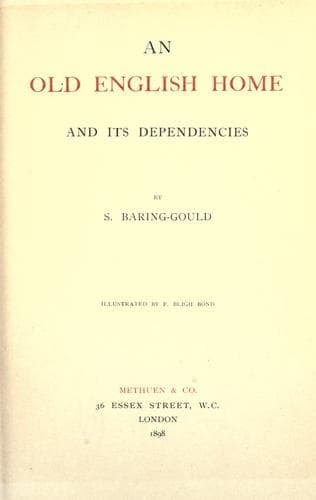
An Old English Home and Its DependenciesBaring-Gould, S. (Sabine)
History
An Old English Home and Its Dependencies
Baring-Gould, S. (Sabine)
England -- Social life and customs
Among the peasants the tenure of small holdings is mischievous; they
are chained to the soil, whereas, if set free, they might emigrate
and become energetic colonists, or go into the towns and become
intelligent, active artisans. It is just when a young man ought to be
starting on a career that he acquires a few acres, and at once he is
paralyzed. Those acres hold him, he cannot do justice to them, he has
not the means. He does not like to part with them, and he spends his
life bowed over them. Worse than this, unable to avert the further
dismemberment of his estate on his death, he resolves in compact with
his wife to have no more than one, or at the most two children. Now,
with us, the younger son of a landed proprietor knows he must push his
way in the world, and from the moment his intelligence begins to act
he looks about him for openings. Our labourers also, unchained to the
soil, go about wherever work may be had. Where there is a market for
their abilities, thither they go, but go they would not, if they owned
their little plot of land and house.
And, if I am not much mistaken, it is this early developed sense of
independence that has been the making of Englishmen all over the world;
but, then, it is the conservative element, the holding to the paternal
acres, that has made of dear old England one great garden and park, the
proprietor spending his money on the land, instead of on his pleasures
or self, as elsewhere.
[Illustration]
[Illustration: THE MANOR HOUSE]
CHAPTER II.
As every circle has its centre, so had every manor its hall, the centre
of its organization, the heart whence throbbed the vital force through
the district, and to which it returned. The hall was not merely the
place where the lord lived, for he did not always occupy it, but it was
the gathering place of the courts leet and baron.
It is the fashion to hold that land was originally held in common, and
that private proprietorship in land is an encroachment on the public
rights.
That was, no doubt, the case with the Celt, and it has been fatal to
his ever taking a lead among the nations; it has so eaten into his
habits of mind as to have rendered him incapable of being other than
a subject under the control of another people, which had happily got
beyond such infantile notions.
It is the case with individuals, starting on the battle of life, that
they sometimes, by chance, take a wrong direction, and then, once
involved therein, have not the power or will or chance to turn back and
take another. That is how some men make a botch of their lives, whereas
others, perhaps their inferiors in ability, by mere accident strike on
a course which leads to power, prosperity, and a name.
It is so among nations, races--and among these the highly-gifted Celt
went wrong at the outstart, and that is it which has been his bane
through centuries. Now the time for recovery is past. He is forced to
take a lower room.
Public-domain text, read in full here on John Shaqi.
Reviews
Reviews
No reviews yet
Be the first to share your thoughts on this work.
Join the Discussion
Join the discussion
Sign in to leave a comment or review.
Sign InorCreate an account