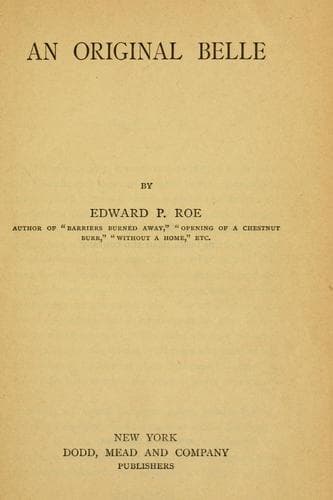
Love stories; United States -- History -- Civil War, 1861-1865 -- Fiction
Marian looked with awakening curiosity and interest at the face
before her, yet it was the familiar visage of her father. She had
seen it all her life, but now felt that she had never before seen
it in its true significance--its strong lines, square jaw, and
quiet gray eyes, with their direct, steady gaze. He had come and
gone before her daily, petted her now and then a little, met her
requests in the main good-humoredly, paid her bills, and would
protect her with his life; yet a sort of dull wonder came over her
as she admitted to herself that he was a stranger to her. She knew
little of his work and duty, less of his thoughts, the mental realm
in which the man himself dwelt. What were its landmarks, what its
characteristic features, she could not tell. One may be familiar
with the outlines of a country on a map, yet be ignorant of the
scenery, productions, inhabitants, governing forces, and principles.
Her very father was to her but a man in outline. She knew little of
the thoughts that peopled his brain, of the motives and principles
that controlled his existence, giving it individuality, and even
less of the resulting action with which his busy life abounded.
Although she had crossed the threshold of womanhood, she was still
to him the self-pleasing child that he had provided for since
infancy; and he was, in her view, the man to whom, according to the
law of nature and the family, she was to look for the maintenance
of her young life, with its almost entire separation in thoughts,
pleasures, and interests. She loved him, of course. She had always
loved him, from the time when she had stretched forth her baby hands
to be taken and fondled for a few moments and then relinquished to
others. Practically she had dwelt with others ever since. Now, as
a result, she did not understand him, nor he her. She would miss
him as she would oxygen from the air. Now she began to perceive
that, although he was the unobtrusive source of her life, home,
education, and the advantages of her lot, he was not impersonal,
but a human being as truly as herself. Did he want more from her
than the common and instinctive affection of a child for its parent?
If to this she added intelligent love, appreciation, and sympathy,
would he care? If she should be able to say, "Papa, I am kin to you,
not merely in flesh and blood, but in mind, hope, and aspiration;
I share with you that which makes your life, with its success and
failure, not as the child who may find luxurious externals curtailed
or increased, but as a sympathetic woman who understands the more
vital changes in spiritual vicissitude,"--if she could truthfully
say all this, would he be pleased and reveal himself to her?
Thoughts like these passed through her mind as they dined together
and drove in the park. When at last they returned and sat in the
dimly-lighted parlor, Mr. Vosburgh recognized that her "mood" had
not passed away.
CHAPTER III.
A NEW FRIEND.
Public-domain text, read in full here on John Shaqi.
Reviews
Reviews
No reviews yet
Be the first to share your thoughts on this work.
Join the Discussion
Join the discussion
Sign in to leave a comment or review.
Sign InorCreate an account