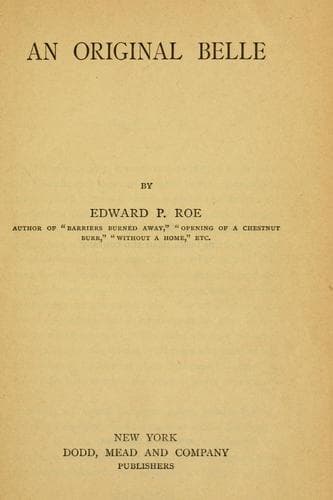
Love stories; United States -- History -- Civil War, 1861-1865 -- Fiction
"MARIAN," asked her father, after smoking awhile in silence, "what
did you mean by your emphatic negative when I asked you if you were
not content to be a conventional woman? How much do you mean?"
"I wish you would help me find out, papa."
"How! don't you know?"
"I do not; I am all at sea."
"Well, my dear, to borrow your own illustration, you can't be far
from shore yet. Why not return? You have seemed entirely satisfied
thus far."
"Were you content with me, papa?"
"I think you have been a very good little girl, as girls go."
"'Good little girl, as girls go;' that's all."
"That's more than can be said of many."
"Papa, I'm not a little girl; I am a woman of twenty years."
"Yes, I know; and quite as sensible as many at forty."
"I am no companion for you."
"Indeed you are; I've enjoyed having you with me this evening
exceedingly."
"Yes, as you would have enjoyed my society ten years ago. I've been
but a little girl to you all the time. Do you know the thought that
has been uppermost in my mind since you joined me?"
"How should I? How long does one thought remain uppermost in a
girl's mind?"
"I don't blame you for your estimate. My thought is this,--we are
not acquainted with each other."
"I think I was acquainted with you, Marian, before this mood began."
"Yes, I think you were; yet I was capable of this 'mood,' as you
call it, before."
"My child," said Mr. Vosburgh, coming to her side and stroking her
hair, "I have spoken more to draw you out than for anything else.
Heaven forbid that you for a moment should think me indifferent to
anything that relates to your welfare! You wish me to advise, to
help you. Before I can do this I must have your confidence, I must
know your thoughts and impulses. You can scarcely have a purpose
yet. Even a quack doctor will not attempt diagnosis or prescribe
his nostrum without some knowledge of the symptoms. When I last
saw you in the country you certainly appeared like a conventional
society girl of an attractive type, and were evidently satisfied
so to remain. You see I speak frankly, and reveal to you my habit
of making quick practical estimates, and of taking the world as I
find it. You say you were capable of this mood--let us call it an
aspiration--before. I do not deny this, yet doubt it. When people
change it is because they are ripe, or ready for change, as
are things in nature. One can force or retard nature; but I don't
believe much in intervention. With many I doubt whether there is
even much opportunity for it. They are capable of only the gradual
modification of time and circumstances. Young people are apt to
have spasms of enthusiasm, or of self-reproach and dissatisfaction.
These are of little account in the long run, unless there is fibre
enough in character to face certain questions, decide them, and
then act resolutely on definite lines of conduct. I have now given
you my views, not as to a little child, but as to a mature woman
of twenty.
Public-domain text, read in full here on John Shaqi.
Reviews
Reviews
No reviews yet
Be the first to share your thoughts on this work.
Join the Discussion
Join the discussion
Sign in to leave a comment or review.
Sign InorCreate an account