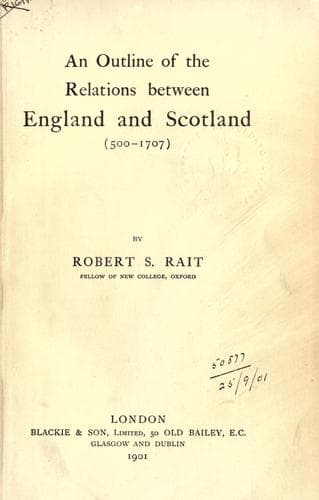
An Outline of the Relations between England and Scotland (500-1707)Rait, Robert S. (Robert Sangster)
History
An Outline of the Relations between England and Scotland (500-1707)
Rait, Robert S. (Robert Sangster)
England -- Foreign relations -- Scotland; Scotland -- Foreign relations -- England
With the general course of the Great Rebellion we are not here
concerned. It is important for our purpose to notice that it affected
Scotland in two ways. The course of events converted, on the one hand,
the Episcopalian party into a Royalist party, and placed at its head the
Covenanter, Montrose. On the other hand, the National Covenant was
transformed into the Solemn League and Covenant, which had for its aim
the establishment of Presbytery in England as well as in Scotland. This
"will o' the wisp" of covenanted uniformity led the Scottish Church into
somewhat strange places. As early as January, 1643, Montrose had offered
to strike a blow for the king in Scotland, but Charles would not take
the responsibility of beginning the strife. In August negotiations began
for the extension of the covenant to England. The Solemn League and
Covenant, which provided for the abolition of Episcopacy in England, was
adopted by the Convention of Estates at Edinburgh on August 17th, and in
the following month it passed both Houses of Parliament in England, and
was taken both by the House of Commons and by the Assembly of Divines at
Westminster. Its only ultimate results were the substitution in Scotland
of the Westminster Confession of Faith, Catechisms, and Directory for
Public Worship, in place of the older Scottish documents, and the
approximation of Scottish Presbytery to English Puritanism, involving a
distinct departure from the ideals of the Scottish Reformation, and the
introduction into Scotland of a form of Sabbatarianism which has come to
be regarded as distinctively Scottish, but which owes its origin,
historically, to English Nonconformity.[89] Its immediate effects were
the short-lived predominance of Presbytery in England, and the crossing
of the Tweed, in January, 1644, by a Scottish army in the pay of the
English Parliament. The part taken by the Scottish army in the war was
not unimportant. In April they aided Fairfax in the siege of York; in
July they took an honourable share in the battle of Marston Moor; they
were responsible for the Uxbridge proposals which provided for peace on
the basis of a Presbyterian settlement. In June, 1645, they advanced
southwards to Mansfield, and, after the surrender of Carlisle, on June
28th, and its occupation by a Scottish garrison, Leven proceeded to
Alcester and thereafter laid siege to Hereford, an attempt which events
in Scotland forced him to abandon. Finally, in May, 1646, the king
surrendered to the Scottish army at Newark, which had been invested by
Leven since the preceding November.
Public-domain text, read in full here on John Shaqi.
Reviews
Reviews
No reviews yet
Be the first to share your thoughts on this work.
Elsewhere in the archive
Join the Discussion
Join the discussion
Sign in to leave a comment or review.
Sign InorCreate an account