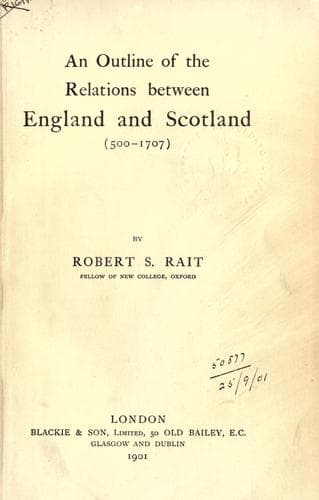
An Outline of the Relations between England and Scotland (500-1707)Rait, Robert S. (Robert Sangster)
History
An Outline of the Relations between England and Scotland (500-1707)
Rait, Robert S. (Robert Sangster)
England -- Foreign relations -- Scotland; Scotland -- Foreign relations -- England
While the Scottish army was thus aiding the Parliamentary cause, the
Earl of Montrose had created an important diversion on the king's side
in Scotland itself. In April, 1644, he occupied Dumfries and made an
unsuccessful attempt on the Scottish Lowlands. In May Charles conferred
on him a marquisate, and in August he prepared to renew the struggle. To
his old foes, the Gordons, he first looked for assistance, but was
finally compelled to raise his forces in the Highlands, and to obtain
Irish aid. On September 1st he gained his first victory at Tippermuir,
near Perth, on which he had marched with his Highland host. From Perth
he marched on Aberdeen, gaining some reinforcements from the northern
gentry, and in particular from the Earl of Airlie. Once again Montrose
fought a battle which delivered the city of Aberdeen into his power
(September 13th), but now he was unwilling or unable to protect the
captured town, which was cruelly ravaged. From Aberdeen Montrose
proceeded by Rothiemurchus to Blair Athole, but suddenly turned
backwards to Aberdeenshire, where he defended Fyvie Castle, slipped past
Argyll, and again reached Blair Athole. The enemies of Argyll crowded to
his banner, but his army was still small when, in December, 1644, he
made his descent upon Argyll, and reached the castle of Inverary. From
Inverary he went northwards, ravaging as he went, till he found, at Loch
Ness, that there was an army of 5000 men under the Earl of Seaforth
prepared to resist his advance, while Argyll was behind him at
Inverlochy. Although Argyll's army considerably outnumbered his own,
Montrose turned southwards and made a rapid dash at Argyll's forces as
they lay at Inverlochy, and won a complete victory, the news of which
dispersed Seaforth's men and enabled Montrose to invite Charles to a
country which lay at his mercy. At Elgin he was joined by the heir of
the Marquis of Huntly, his forces increased, and the excommunication
which the Church immediately published against him seemed of but little
importance. On April 4th he seized Dundee, and on May 9th won a fresh
victory at Auldearn, which was followed, in rapid succession, by a
victory at Alford in July, and in August by the "crowning mercy" of
Kilsyth, which made him master of the situation, and forced Leven to
raise the siege of Hereford. From Kilsyth he marched to Glasgow, where
both the Highlanders and the Gordons began to desert him. From England,
Leven sent David Leslie to meet Montrose as he marched by the Lothians
into the border counties. On September 13th, 1645, just one year after
his victory at Aberdeen, Montrose was completely defeated at
Philiphaugh. He escaped, but his power was broken, and he was unable
henceforth to take any important share in the war.
Public-domain text, read in full here on John Shaqi.
Reviews
Reviews
No reviews yet
Be the first to share your thoughts on this work.
Elsewhere in the archive
Join the Discussion
Join the discussion
Sign in to leave a comment or review.
Sign InorCreate an account