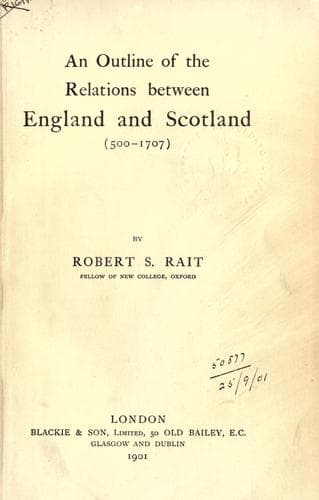
An Outline of the Relations between England and Scotland (500-1707)Rait, Robert S. (Robert Sangster)
History
An Outline of the Relations between England and Scotland (500-1707)
Rait, Robert S. (Robert Sangster)
England -- Foreign relations -- Scotland; Scotland -- Foreign relations -- England
crisis which threatened them, they proceeded no further than to bring in
an Act abolishing Prelacy and all superiority of office in the Church of
Scotland.
While William's first Parliament was debating, his enemies were entering
upon a struggle which was destined to be brief. Edinburgh Castle held
out for King James till June 14th, 1689, when its captain, the Duke of
Gordon, capitulated. Graham of Claverhouse, now Viscount Dundee, had
collected an army of Highlanders, against whom William sent General
Mackay, a Scotsman who had served in Holland. Mackay followed Dundee
through the Highlands to Elgin and on to Inverness, and finally, after
many wanderings, the two armies met in the pass of Killiecrankie. Dundee
and his Highlanders were victorious, but Dundee himself was killed in
the battle, and his death proved a fatal blow to the Jacobite cause.
After some delay Mackay was able to attain the object for which the
battle had been fought--the possession of Blair Athole Castle. The
military resistance soon came to an end.
The ecclesiastical settlement followed the suppression of the
rebellion. The deprivation of nonjuring clergymen had been proceeding
since the establishment of the new Government, and in 1690 an act was
passed restoring to their parishes the Presbyterian clergy who had been
ejected under Charles II. A small temporary provision was made for their
successors, who were now, in turn, expelled. On the 26th May, 1690, the
Parliament adopted the Confession of Faith, although it refused to be
committed to the Covenant. The Presbyterian form of Church government
was established; but King William succeeded in maintaining some check on
the General Assembly, and toleration was granted to such Episcopalian
dissenters as were willing to take the oath of allegiance. On the other
hand, acceptance of the Confession of Faith was made a test for
professors in the universities. The changes were carried out with little
disturbance to the peace, there was no blood spilt, and except for some
rough usage of Episcopalians in the west (known as the "rabbling of the
curates"), there was nothing in the way of outrage or insult. The credit
of the settlement belongs to William Carstares, afterwards Principal of
the University of Edinburgh, whose tact and wisdom overcame many
difficulties.
Public-domain text, read in full here on John Shaqi.
Reviews
Reviews
No reviews yet
Be the first to share your thoughts on this work.
Elsewhere in the archive
Join the Discussion
Join the discussion
Sign in to leave a comment or review.
Sign InorCreate an account