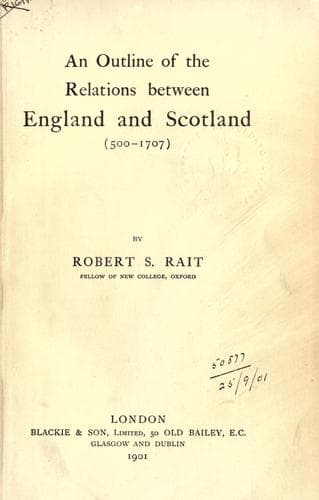
An Outline of the Relations between England and Scotland (500-1707)Rait, Robert S. (Robert Sangster)
History
An Outline of the Relations between England and Scotland (500-1707)
Rait, Robert S. (Robert Sangster)
England -- Foreign relations -- Scotland; Scotland -- Foreign relations -- England
The personal union of Scotland and England had created no special
difficulties while both countries were under the rule of an absolute
monarch. The policy of both was alike, because it was guided by one
supreme ruler. But the accession of a constitutional king, with a
parliamentary title, at once created many problems difficult of
solution, and made a more complete union absolutely necessary. The Union
of 1707 was thus the natural consequence of the Revolution of 1689,
although, at the time of the Revolution, scrupulous care was taken,
alike by the new king and by his English Parliament, to recognize the
existence of Scotland as a separate kingdom. The Scottish Parliament,
which regarded itself as the ruler of the country, found itself hampered
and restricted by William's action. It was allowed no voice on questions
of foreign policy, and its conduct of home affairs met with not
infrequent interference, which roused the indignation of Scottish
politicians, and especially of the section which followed Fletcher of
Saltoun. Several causes combined to add to the unpopularity which
William had acquired through the occasional friction with the
Parliament. Scotland had ceased to have any interest in the war, and its
prolongation constituted a standing grievance, of which the partisans of
the Stuarts were not slow to avail themselves.
There were two events, in particular, which roused widespread resentment
in Scotland. These were the Massacre of Glencoe, and the failure of the
scheme for colonizing the Isthmus of Darien. The story of Glencoe has
been often told. The 31st December, 1691, had been appointed as the
latest day on which the government would receive the submission of the
Highland chiefs. MacDonald of Glencoe delayed till the last moment, and
then proceeded to Fort-William, where a fortress had just been erected,
to take the oath in the presence of its commander, who had no power to
receive it. From Fort-William he had to go to Inverary, to take the oath
before the sheriff of Argyll, and he did so on the 6th January, 1692.
The six days' delay placed him and his clan in the power of men who were
unlikely to show any mercy to the name of MacDonald. Acting under
instructions from King William, the nature of which has been matter of
dispute, Campbell of Glenlyon, acting with the knowledge of Breadalbane
and Sir John Dalrymple of Stair, the Secretary of State, and as their
tool, entered the pass of Glencoe on the 1st February, 1692. The
MacDonalds, trusting in the assurances which had been given by the
Government, seem to have suspected no evil from this armed visit of
their traditional enemies, the Campbells, and received them with
hospitality. While they were living peaceably, all possible retreat was
being cut off from the unfortunate MacDonalds by the closing of the
passes, and on the 13th effect was given to the dastardly scheme. It
failed, however, to achieve its full object--the extirpation of the
clan.
Public-domain text, read in full here on John Shaqi.
Reviews
Reviews
No reviews yet
Be the first to share your thoughts on this work.
Elsewhere in the archive
Join the Discussion
Join the discussion
Sign in to leave a comment or review.
Sign InorCreate an account