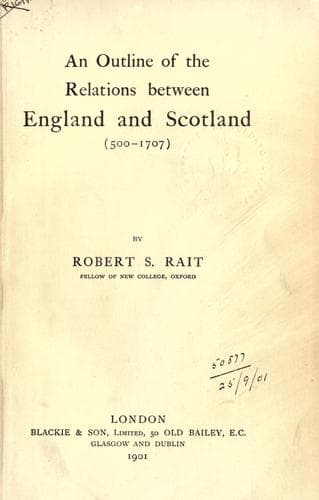
An Outline of the Relations between England and Scotland (500-1707)Rait, Robert S. (Robert Sangster)
History
An Outline of the Relations between England and Scotland (500-1707)
Rait, Robert S. (Robert Sangster)
England -- Foreign relations -- Scotland; Scotland -- Foreign relations -- England
Many escaped to the hills; but the chief himself and over thirty
others were murdered in cold blood. The news of the massacre roused a
fierce flame of indignation, not only in the Highlands, but throughout
the Lowlands as well, and the Jacobites did not fail to make use of it.
A commission was appointed to enquire into the circumstances, and it
severely censured Dalrymple, and charged Breadalbane with treason, while
many blamed, possibly unjustly, the king himself.
The other grievance was of a different nature. About 1695, William
Paterson, the founder of the Bank of England, suggested the formation of
a Scottish company to trade to Africa and the Indies. It was originally
known as the African Company, but it was destined to be popularly
remembered by the name of its most notable failure--the Darien Company.
It received very full powers from the Scottish Parliament, powers of
military colonization as well as trading privileges. These powers
aroused great jealousy and indignation in England, and the House of
Commons decided that, as the company had its headquarters in London, the
directors were guilty of high crimes and misdemeanours. There followed a
failure of the English capital on which the promoters had reckoned, but
shares to the value of L400,000 (on which L219,094 was paid up) were
subscribed in Scotland. At first the company was a prosperous trading
concern, but its only attempt at colonization involved it in ruin.
Paterson wished his fellow-countrymen to found a colony in the Isthmus
of Panama, and to attract thither the whole trade of North and South
America. The ports of the colony were to be open to ships of all
nations. In the end of 1698 twelve hundred Scots landed on the shore of
the Gulf of Darien, without organization and without the restraint of
responsibility to any government. They soon had difficulties with their
Spanish neighbours, and the English colonists at New York, Barbadoes,
and Jamaica were warned to render them no assistance. Disease and famine
completed the tale of misery, and the first colonists deserted their
posts. Their successors, who arrived to find empty huts, surrounded by
lonely Scottish graves, were soon in worse plight, and they were driven
out by a band of Spaniards. The unfortunate company lingered on for some
time, but merely as traders. The Scots blamed the king's ill-will for
their failure, and he became more than ever unpopular in Scotland. The
moral of the whole story was that only through the corporate union of
the two countries could trade jealousies and the danger of rival schemes
of colonization be avoided.
Public-domain text, read in full here on John Shaqi.
Reviews
Reviews
No reviews yet
Be the first to share your thoughts on this work.
Elsewhere in the archive
Join the Discussion
Join the discussion
Sign in to leave a comment or review.
Sign InorCreate an account