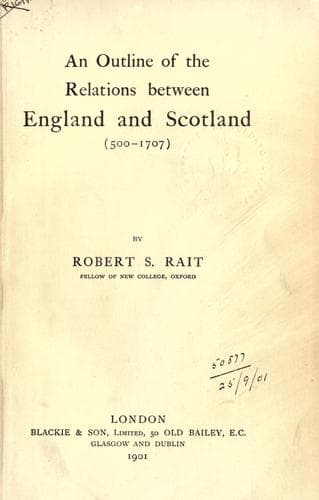
An Outline of the Relations between England and Scotland (500-1707)Rait, Robert S. (Robert Sangster)
History
An Outline of the Relations between England and Scotland (500-1707)
Rait, Robert S. (Robert Sangster)
England -- Foreign relations -- Scotland; Scotland -- Foreign relations -- England
institutions, and he brings all Scotland under the same condemnation
when he tells us how David "did his utmost to draw on that rough and
boorish people towards quiet and chastened manners".[15] The reference
to "their own nation" shows, too, that Fordun did not understand that
the Highlanders were a different people; and when he called them hostile
to the English, he was evidently unaware that their custom was "out of
hatred to the Saxons nearest them" to league with the English. John
Major, writing in the reign of James IV (1489-1513), mentions the
differences between Highlander and Lowlander. The wild Scots speak
Irish; the civilized Scots use English. "But", he adds, "most of us
spoke Irish a short time ago."[16] His contemporary, Hector Boece, who
made the Tour to the Hebrides, says: "Those of us who live on the
borders of England have forsaken our own tongue and learned English,
being driven thereto by wars and commerce. But the Highlanders remain
just as they were in the time of Malcolm Canmore, in whose days we began
to adopt English manners."[17] When Bishop Elphinstone applied, in 1493,
for Papal permission to found a university in Old Aberdeen, in proximity
to the barbarian Highlanders, he made no suggestion of any racial
difference between the English-speaking population of Aberdeen and their
Gaelic-speaking neighbours.[18] Late in the sixteenth century, John
Lesley, the defender of Queen Mary, who had been bishop of Ross, and
came of a northern family, wrote in a strain similar to that of Major
and Boece. "Foreign nations look on the Gaelic-speaking Scots as wild
barbarians because they maintain the customs and the language of their
ancestors; but we call them Highlanders."[19]
Public-domain text, read in full here on John Shaqi.
Reviews
Reviews
No reviews yet
Be the first to share your thoughts on this work.
Join the Discussion
Join the discussion
Sign in to leave a comment or review.
Sign InorCreate an account