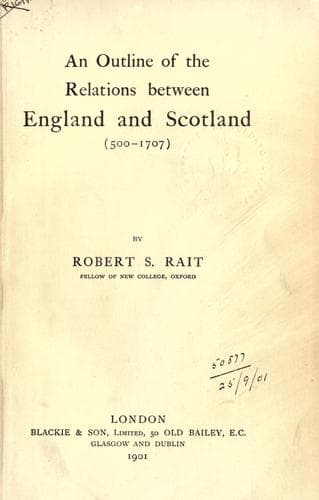
An Outline of the Relations between England and Scotland (500-1707)Rait, Robert S. (Robert Sangster)
History
An Outline of the Relations between England and Scotland (500-1707)
Rait, Robert S. (Robert Sangster)
England -- Foreign relations -- Scotland; Scotland -- Foreign relations -- England
Even in connexion with the battle of Harlaw, we find that Scottish
historians do not use such terms in speaking of the Highland forces as
Mr. Hill Burton would lead us to expect. Of the two contemporary
authorities, one, the Book of Pluscarden, was probably written by a
Highlander, while the continuation of Fordun's _Scoti-chronicon_, in
which we have a more detailed account of the battle, was the work of
Bower, a Lowlander who shared Fordun's antipathy to Highland customs.
The _Liber Pluscardensis_ mentions the battle in a very casual manner.
It was fought between Donald of the Isles and the Earl of Mar; there was
great slaughter: and it so happened that the town of Cupar chanced to be
burned in the same year.[20] Bower assigns a greater importance to the
affair;[21] he tells us that Donald wished to spoil Aberdeen and then to
add to his own possessions all Scotland up to the Tay. It is as if he
were writing of the ambition of the House of Douglas. But there is no
hint of racial antipathy; the abuse applied to Donald and his followers
would suit equally well for the Borderers who shouted the Douglas
battle-cry. John Major tells us that it was a civil war fought for the
spoil of the famous city of Aberdeen, and he cannot say who won--only
the Islanders lost more men than the civilized Scots. For him, its chief
interest lay in the ferocity of the contest; rarely, even in struggles
with a foreign foe, had the fighting been so keen.[22] The fierceness
with which Harlaw was fought impressed the country so much that, some
sixty years later, when Major was a boy, he and his playmates at the
Grammar School of Haddington used to amuse themselves by mock fights in
which they re-enacted the red Harlaw.
From Major we turn with interest to the Principal of the University and
King's College, Hector Boece, who wrote his _History of Scotland_, at
Aberdeen, about a century after the battle of Harlaw, and who shows no
trace of the strong feeling described by Mr. Hill Burton. He narrates
the origin of the quarrel with much sympathy for the Lord of the Isles,
and regrets that he was not satisfied with recovering his own heritage
of Ross, but was tempted by the pillage of Aberdeen, and he speaks of
the Lowland army as "the Scots on the other side".[23] His narrative in
the _History_ is devoid of any racial feeling whatsoever, and in his
_Lives of the Bishops of Aberdeen_ he omits any mention of Harlaw at
all. We have laid stress upon the evidence of Boece because in Aberdeen,
if anywhere, the memory of the "Celtic peril" at Harlaw should have
survived. Similarly, George Buchanan speaks of Harlaw as a raid for
purposes of plunder, made by the islanders upon the mainland.[24] These
illustrations may serve to show how Scottish historians really did look
upon the battle of Harlaw, and how little do they share Mr. Burton's
horror of the Celts.
Public-domain text, read in full here on John Shaqi.
Reviews
Reviews
No reviews yet
Be the first to share your thoughts on this work.
Join the Discussion
Join the discussion
Sign in to leave a comment or review.
Sign InorCreate an account