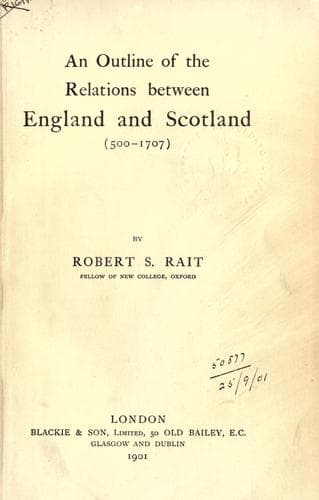
An Outline of the Relations between England and Scotland (500-1707)Rait, Robert S. (Robert Sangster)
History
An Outline of the Relations between England and Scotland (500-1707)
Rait, Robert S. (Robert Sangster)
England -- Foreign relations -- Scotland; Scotland -- Foreign relations -- England
[Footnote 3: _History of the English People_, Book III, c. iv.]
[Footnote 4: _History of Scotland_, vol. i, p. 2. But, as Mr. Lang
expressly repudiates any theory of displacement north of the Forth, and
does not regard Harlaw in the light of a great racial contest, his
position is not really incompatible with that of the present work.]
[Footnote 5: _History of England_, p. 158. Mr. Oman is almost alone in
not calling them English in blood.]
[Footnote 6: _History of Scotland_, vol. ii, pp. 393-394.]
[Footnote 7: Instances of the first tendency are Edderton, near Tain,
_i.e._ _eadar duin_ ("between the hillocks"), and Falkirk, _i.e._
_Eaglais_ ("speckled church"), while examples of the second tendency are
too numerous to require mention. Examples of ecclesiastical names are
Laurencekirk and Kirkcudbright, and the growth of commerce receives the
witness of such names as Turnberry, on the coast of Ayr, dating from the
thirteenth century, and Burghead on the Moray Firth.]
[Footnote 8: Cf. _Waverley_, c. xliii, and the concluding chapter of
_Tales of a Grandfather_.]
[Footnote 9: William of Newburgh states this in a probably exaggerated
form when he says:--"Regni Scottici oppida et burgi ab Anglis habitari
noscuntur" (Lib. II, c. 34). The population of the towns in the Lothians
was, of course, English.]
[Footnote 10: For the real significance of such grants of land, cf.
Maitland, _Domesday Book and Beyond_, Essay II.]
[Footnote 11: _Scotland under her Early Kings_, vol. i, p. 239.]
[Footnote 12: Annalia, iv.]
[Footnote 13: There is a possible exception in Barbour's _Bruce_ (Bk.
XVIII, 1. 443)--"Then gat he all the Erischry that war intill his
company, of Argyle and the Ilis alswa". It has been generally understood
that the "Erischry" here are the Scottish Highlanders; but it is certain
that Barbour frequently uses the word to mean Irishmen, and it is
perhaps more probable that he does so here also than that he should use
the word in this sense only once, and with no parallel instance for more
than a century.]
[Footnote 14: Chronicle, Book II, c. ix. Cf. App. A.]
[Footnote 15: Ibid, Book V, c. x. Cf. App. A.]
[Footnote 16: _History of Greater Britain_, Bk. I, cc. vii, viii, ix.
Cf. App. A.]
[Footnote 17: _Scotorum Regni Descriptio_, prefixed to his "History".
Cf. App. A.]
[Footnote 18: _Fasti Aberdonenses_, p. 3.]
[Footnote 19: _De Gestis Scotorum_, Lib. I. Cf. App. A. It is
interesting to note, as showing how the breach between Highlander and
Lowlander widened towards the close of the sixteenth century, that
Father James Dalrymple, who translated Lesley's History, at Ratisbon,
about the beginning of the seventeenth century, wrote: "Bot the rest of
the Scottis, quhome _we_ halde as outlawis and wylde peple". Dalrymple
was probably a native of Ayrshire.]
[Footnote 20: _Liber Pluscardensis_, X, c. xxii. Cf. App. A.]
[Footnote 21: _Scoti-chronicon_, XV, c. xxi. Cf. App. A.]
Public-domain text, read in full here on John Shaqi.
Reviews
Reviews
No reviews yet
Be the first to share your thoughts on this work.
Join the Discussion
Join the discussion
Sign in to leave a comment or review.
Sign InorCreate an account