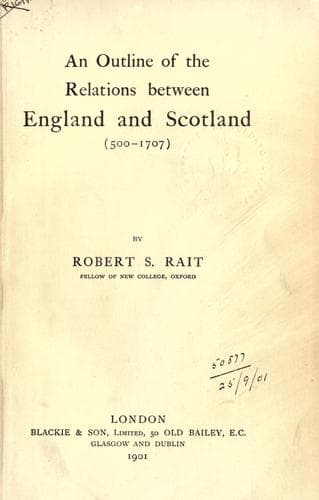
An Outline of the Relations between England and Scotland (500-1707)Rait, Robert S. (Robert Sangster)
History
An Outline of the Relations between England and Scotland (500-1707)
Rait, Robert S. (Robert Sangster)
England -- Foreign relations -- Scotland; Scotland -- Foreign relations -- England
[Footnote 22: _Greater Britain_, VI, c. x. Cf. App. A. The keenness of
the fighting is no proof of racial bitterness. Cf. the clan fight on the
Inches at Perth, a few years before Harlaw.]
[Footnote 23: _Scotorum Historiae_, Lib. XVI. Cf. App. A.]
[Footnote 24: _Rerum Scotorum Historia_, Lib. X. Cf. App. A.]
[Footnote 25: _Top. Hib._, Dis. III, cap. xi.]
[Footnote 26: _Britannia_, section _Scoti_.]
[Footnote 27: Mahoun = Mahomet, _i.e._ the Devil.]
[Footnote 28: The Editor of the Scottish Text Society's edition of
Dunbar points out that "Macfadyane" is a reference to the traitor of the
War of Independence:
"This Makfadzane till Inglismen was suorn;
Eduard gaiff him bath Argill and Lorn".
Blind Harry, VII, ll. 627-8.
]
[Footnote 29: "Far northward in a nuke" is a reference to the cave in
which Macfadyane was killed by Duncan of Lorne (Bk. VIII, ll. 866-8).]
CHAPTER I
RACIAL DISTRIBUTION AND FEUDAL RELATIONS
_c._ 500-1066 A.D.
Since the beginning of the eighteenth century, it has been customary to
speak of the Scottish Highlanders as "Celts". The name is singularly
inappropriate. The word "Celt" was used by Caesar to describe the peoples
of Middle Gaul, and it thence became almost synonymous with "Gallic".
The ancient inhabitants of Gaul were far from being closely akin to the
ancient inhabitants of Scotland, although they belong to the same
general family. The latter were Picts and Goidels; the former, Brythons
or Britons, of the same race as those who settled in England and were
driven by the Saxon conquerors into Wales, as their kinsmen were driven
into Brittany by successive conquests of Gaul. In the south of Scotland,
Goidels and Brythons must at one period have met; but the result of the
meeting was to drive the Goidels into the Highlands, where the Goidelic
or Gaelic form of speech still remains different from the Welsh of the
descendants of the Britons. Thus the only reason for calling the
Scottish Highlanders "Celts" is that Caesar used that name to describe a
race cognate with another race from which the Highlanders ought to be
carefully distinguished. In none of our ancient records is the term
"Celt" ever employed to describe the Highlanders of Scotland. They never
called themselves Celtic; their neighbours never gave them such a name;
nor would the term have possessed any significance, as applied to them,
before the eighteenth century. In 1703, a French historian and Biblical
antiquary, Paul Yves Pezron, wrote a book about the people of Brittany,
entitled _Antiquite de la Nation et de la Langue des Celtes autrement
appellez Gaulois_. It was translated into English almost immediately,
and philologists soon discovered that the language of Caesar's Celts was
related to the Gaelic of the Scottish Highlanders. On this ground
progressed the extension of the name, and the Highlanders became
identified with, instead of being distinguished from, the Celts of Gaul.
Public-domain text, read in full here on John Shaqi.
Reviews
Reviews
No reviews yet
Be the first to share your thoughts on this work.
Join the Discussion
Join the discussion
Sign in to leave a comment or review.
Sign InorCreate an account