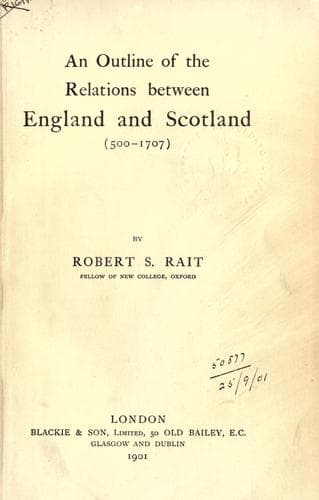
An Outline of the Relations between England and Scotland (500-1707)Rait, Robert S. (Robert Sangster)
History
An Outline of the Relations between England and Scotland (500-1707)
Rait, Robert S. (Robert Sangster)
England -- Foreign relations -- Scotland; Scotland -- Foreign relations -- England
The Norman Conquest of England could not fail to modify the position of
Scotland. Just as the Roman and the Saxon conquests had, in turn, driven
the Brythons northwards, so the dispossessed Saxons fled to Scotland
from their Norman victors. The result was considerably to alter the
ecclesiastical arrangements of the country, and to help its advance
towards civilization. The proportion of Anglo-Saxons to the races who
are known as Celts must also have been increased; but a complete
de-Celticization of Southern Scotland could not, and did not, follow.
The failure of William's conquest to include the Northern counties of
England left Northumbria an easy prey to the Scottish king, and the
marriage of Malcolm III, known as Canmore, to Margaret, the sister of
Edgar the AEtheling, gave her husband an excuse for interference in
England. We, accordingly, find a long series of raids over the border,
of which only five possess any importance. In 1069-70, Malcolm (who had,
even in the Confessor's time, been in Northumberland with hostile
intent) conducted an invasion in the interests of his brother-in-law.
It is probable that this movement was intended to coincide with the
arrival of the Danish fleet a few months earlier. But Malcolm was too
late; the Danes had gone home, and, in the interval, William had himself
superintended the great harrying of the North which made Malcolm's
subsequent efforts somewhat unnecessary. The invasion is important only
as having provoked the counter-attack of the Conqueror, which led to the
renewal of the supremacy controversy. William marched into Scotland and
crossed the Forth (the first English king to do so since the unfortunate
Egfrith, who fell at Nectansmere in 685). At Abernethy, on the banks of
the Tay, Malcolm and William met, and the English Chronicle, as usual,
informs us that the King of Scots became the "man" of the English king.
But as Malcolm received from William twelve _villae_ in England, it is,
at least, doubtful whether Malcolm paid homage for these alone or also
for Lothian and Cumbria, or for either of them. There is, at all events,
no question about the _villae_. Scottish historians have not failed to
point out that the value of the homage, for whatever it was given, is
sufficiently indicated by Malcolm's dealings with Gospatric of
Northumberland, whom William dismissed as a traitor and rebel. Within
about six months of the Abernethy meeting, Malcolm gave Gospatric the
earldom of Dunbar, and he became the founder of the great house of
March. No further invasion took place till 1079, when Malcolm took
advantage of William's Norman difficulties to make another harrying
expedition, which afforded the occasion for the building of
Newcastle-upon-Tyne. The accession of Rufus and his difficulties with
Robert of Normandy led, in 1091, to a somewhat belated attempt by
Malcolm to support the claims of the AEtheling by a third invasion, and,
in the following year, peace was made. Rufus confirmed to Malcolm the
Public-domain text, read in full here on John Shaqi.
Reviews
Reviews
No reviews yet
Be the first to share your thoughts on this work.
Join the Discussion
Join the discussion
Sign in to leave a comment or review.
Sign InorCreate an account