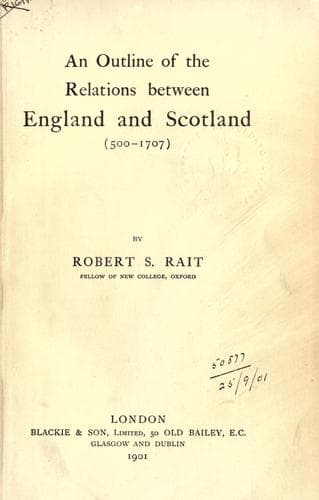
An Outline of the Relations between England and Scotland (500-1707) — John Shaqi
An Outline of the Relations between England and Scotland (500-1707)Rait, Robert S. (Robert Sangster)
History
An Outline of the Relations between England and Scotland (500-1707)
Rait, Robert S. (Robert Sangster)
England -- Foreign relations -- Scotland; Scotland -- Foreign relations -- England
grant of twelve _villae_, and Malcolm in turn gave the English king such
homage as he had given to his father. What this vague statement meant,
it was reserved for the Bruce to determine, and the Bruces had, as yet,
not one foot of Scottish soil. The agreement made in 1092 did not
prevent Rufus from completing his father's work by the conquest of
Cumberland, to which the Scots had claims. Malcolm's indignation and
William's illness led to a famous meeting at Gloucester, whence Malcolm
withdrew in great wrath, declining to be treated as a vassal of England.
The customary invasion followed, with the result that Malcolm was slain
at Alnwick in November, 1093.
But the great effects of the Norman Conquest, as regards Scotland, are
not connected with strictly international affairs. They are partially
racial, and, in other respects, may be described as personal. It is
unquestionable that there was an immigration of the Northumbrian
population into Scotland; but the Northumbrian population were
Anglo-Danish, and the north of England was not thickly populated. When
William the Conqueror ravaged the northern counties with fire and sword,
a considerable proportion of the population must have perished. The
actual infusion of English blood may thus be exaggerated; but the
introduction of English influences cannot be questioned. These
influences were mainly due to the personality of Malcolm's second wife,
the Saxon princess, Margaret. The queen was a woman of considerable
mental power, and possessed a great influence over her strong-headed and
hot-tempered husband. She was a devout churchwoman, and she immediately
directed her energies to the task of bringing the Scottish church into
closer communion with the Roman. The changes were slight in themselves;
all that we know of them is an alteration in the beginning of Lent, the
proper observance of Easter and of Sunday, and a question, still
disputed, about the tonsure. But, slight as they were, they stood for
much. They involved the abandonment of the separate position held by the
Scottish Church, and its acceptance of a place as an integral portion of
Roman Christianity. The result was to make the Papacy, for the first
time, an important factor in Scottish affairs, and to bridge the gulf
that divided Scotland from Continental Europe. We soon find Scottish
churchmen seeking learning in France, and bringing into Scotland those
French influences which were destined seriously to affect the
civilization of the country. But, above all, these Roman changes were
important just because they were Anglican--introduced by an English
queen, carried out by English clerics, emanating from a court which was
rapidly becoming English. Malcolm's subjects thenceforth began to adopt
English customs and the English tongue, which spread from the court of
Queen Margaret. The colony of English refugees represented a higher
civilization and a more advanced state of commerce than the Scottish
Public-domain text, read in full here on John Shaqi.
Reviews
Reviews
No reviews yet
Be the first to share your thoughts on this work.
Join the Discussion
Join the discussion
Sign in to leave a comment or review.
Sign InorCreate an account