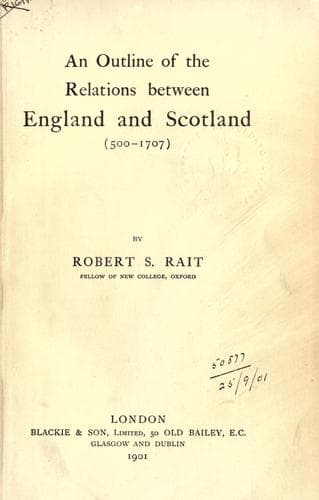
An Outline of the Relations between England and Scotland (500-1707)Rait, Robert S. (Robert Sangster)
History
An Outline of the Relations between England and Scotland (500-1707)
Rait, Robert S. (Robert Sangster)
England -- Foreign relations -- Scotland; Scotland -- Foreign relations -- England
Edgar died in January, 1106-7, and
his brother and successor, Alexander I, espoused an Anglo-Norman,
Sybilla, who is generally supposed to have been a natural daughter of
Henry I. On the death of Alexander, in 1124, these Norman influences
acquired a new importance under his brother David, the youngest son of
Malcolm and Margaret. During the troubles which followed his father's
death, David had been educated in England, and after the marriage of
Henry I and Matilda, had resided at the court of his brother-in-law,
till the death of Edgar, when he became ruler of Cumbria and the
southern portion of Lothian. He had married, in 1113-14, the daughter
and heiress of Waltheof, Earl of Huntingdon, who was also the widow of a
Norman baron. In this way the earldom of Huntingdon became attached to
the Scottish throne, and afforded an occasion for reviving the old
question of homage. Moreover, Waltheof of Huntingdon was the son of
Siward of Northumbria, and David regarded himself as, on this account,
possessing claims over Northumbria.
David, as we have seen, had been brought up under Norman influences, and
it is under the son of the Saxon Margaret that the bloodless Norman
conquest of Scotland took place. Edgar had recognized the new English
nobility and settlers by addressing charters to all in his kingdom,
"both Scots and English"; his brother, David, speaks of "French and
English, Scots and Galwegians". The charters are, of course, addressed
to barons and land-owners, and their evidence refers to the English and
Anglo-Norman nobility. The Norman fascination, which had been turned to
such good account in England, in Italy, and in the Holy Land, had
completely vanquished such English prepossessions as David might have
inherited from his mother. Normans, like the Bruces and the Fitzalans
(afterwards the Stewarts), came to David's court and received from him
grants of land. The number of Norman signatures that attest his charters
show that his _entourage_ was mainly Norman. He was a very devout
Church-man (a "sair sanct for the Crown" as James VI called him), and
Norman prelate and Norman abbot helped to increase the total of Norman
influence. He transformed Scotland into a feudal country, gave grants of
land by feudal tenure, summoned a great council on the feudal principle,
and attempted to create such a monarchy as that of which Henry I was
laying the foundations. There can be little doubt that this strong
Norman influence helped to prepare the Scottish people for the French
alliance; but its more immediate effect was to bring about the existence
of an anti-national nobility. These great Norman names were to become
great in Scottish story; but it required a long process to make their
bearers, in any sense, Scotsmen. Most of them had come from England,
many of them held lands in England, and none of them could be expected
to feel any real difference between themselves and their English
fellows.
Public-domain text, read in full here on John Shaqi.
Reviews
Reviews
No reviews yet
Be the first to share your thoughts on this work.
Join the Discussion
Join the discussion
Sign in to leave a comment or review.
Sign InorCreate an account