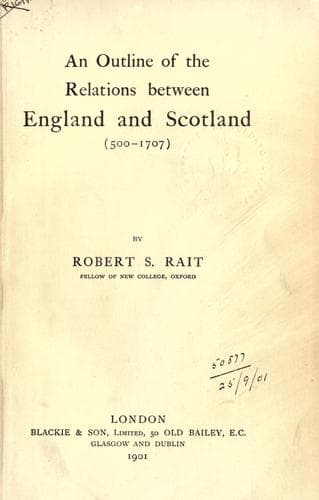
An Outline of the Relations between England and Scotland (500-1707) — John Shaqi
An Outline of the Relations between England and Scotland (500-1707)Rait, Robert S. (Robert Sangster)
History
An Outline of the Relations between England and Scotland (500-1707)
Rait, Robert S. (Robert Sangster)
England -- Foreign relations -- Scotland; Scotland -- Foreign relations -- England
During the reign of Henry I, Anglo-Norman influences thus worked a great
change in Scotland. On Henry's death, David, as the uncle of the Empress
Matilda, immediately took up arms on her behalf. Stephen, with the
wisdom which characterized the beginning of his reign, came to terms
with him at Durham. David did not personally acknowledge the usurper,
but his son, Henry, did him homage for Huntingdon and some possessions
in the north (1136). In the following year, David claimed
Northumberland for Henry as the representative of Siward, and, on
Stephen's refusal, again adopted the cause of the empress. The usual
invasion of England followed, and after some months of ravaging, a short
truce, and a slight Scottish victory gained at Clitheroe on the Ribble,
in June, 1138, the final result was David's great defeat in the battle
of the Standard, fought near Northallerton on the 22nd August, 1138.
The battle of the Standard possesses no special interest for students of
the art of war. The English army, under William of Albemarle and Walter
l'Espec, was drawn up in one line of battle, consisting of knights in
coats of mail, archers, and spearmen. The Scots were in four divisions;
the van was composed of the Picts of Galloway, the right wing was led by
Prince Henry, and the men of Lothian were on the left. Behind fought
King David, with the men of Moray. The Galwegians made several
unsuccessful attempts upon the English centre. Prince Henry led his
horse through the English left wing, but the infantry failed to follow,
and the prince lost his advantage by a premature attempt to plunder. The
Scottish right made a pusillanimous attempt on the English left, and the
reserve began to desert King David, who collected the remnants of his
army and retired in safety to a height above Cowton Moor, the scene of
the fight. Prince Henry was left surrounded by the enemy, but saved the
position by a clever stratagem, and rejoined his father. Mr. Oman
remarks that the battle was "of a very abnormal type for the twelfth
century, since the side which had the advantage in cavalry made no
attempt to use it, while that which was weak in the all-important arm
made a creditable attempt to turn it to account by breaking into the
hostile flank.... Wild rushes of unmailed clansmen against a steady
front of spears and bows never succeeded; in this respect Northallerton
is the forerunner of Dupplin, Halidon Hill, Flodden, and Pinkie."[34]
The chief interest, for our purpose, attaching to the battle of the
Standard, is connected with the light it throws upon the racial
complexion of the country seventy years after the Norman Conquest. Our
chief authorities are the Hexham chroniclers and Ailred of Rivaulx[35],
English writers of the twelfth century. They speak of David's host as
composed of Angli, Picti, and Scoti. The Angli alone contained mailed
knights in their ranks, and David's first intention was to send these
Public-domain text, read in full here on John Shaqi.
Reviews
Reviews
No reviews yet
Be the first to share your thoughts on this work.
Join the Discussion
Join the discussion
Sign in to leave a comment or review.
Sign InorCreate an account