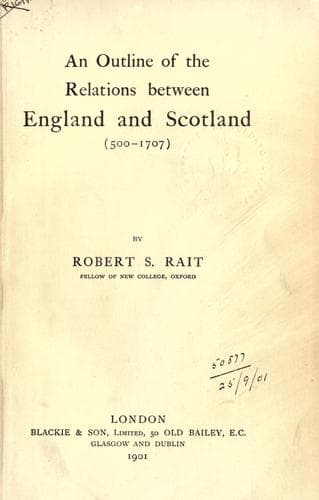
An Outline of the Relations between England and Scotland (500-1707) — John Shaqi
An Outline of the Relations between England and Scotland (500-1707)Rait, Robert S. (Robert Sangster)
History
An Outline of the Relations between England and Scotland (500-1707)
Rait, Robert S. (Robert Sangster)
England -- Foreign relations -- Scotland; Scotland -- Foreign relations -- England
About the political relationship there could be no such doubt. William
stood, theoretically, if not actually, in much the same position to
Henry II, as John Baliol afterwards occupied to Edward I. It was not
till the accession of Richard I that William recovered his freedom. The
castles in the south of Scotland which had been delivered to the English
were restored, and the independence of Scotland was admitted, on
William's paying Richard the sum of 10,000 marks. This agreement, dated
December, 1189, annulled the terms of the Treaty of Falaise, and left
the position of William the Lion exactly what it had been at the death
of Malcolm IV. He remained liegeman for such lands as the Scottish kings
had, in times past, done homage to England. The agreement with Richard I
is certainly not incompatible with the Scottish position that the
homage, before the Treaty of Falaise, applied only to the earldom of
Huntingdon; but the usual vagueness was maintained, and the arrangement
in no way determines the question of the homage paid by the earlier
Scottish kings. For a hundred years after this date, the two countries
were never at war. William had difficulties with John; in 1209, an
outbreak of hostilities seemed almost certain, but the two kings came to
terms. The long reign of William came to an end in 1214. His son and
successor, Alexander II, joined the French party in England which was
defeated at Lincoln in 1216. Alexander made peace with the regent,
resigned all claims to Northumberland, and did homage for his English
possessions--the most important of which was the earldom of Huntingdon,
which had, since 1190, been held by his uncle, David, known as David of
Huntingdon. In 1221, he married Joanna, sister of Henry III. Another
marriage, negotiated at the same time, was probably of more real
importance. Margaret, the eldest daughter of William the Lion, became
the wife of the Justiciar of England, Hubert de Burgh. Mr. Hume Brown
has pointed out that immediately on the fall of Hubert de Burgh, a
dispute arose between Henry and Alexander. The English king desired
Alexander to acknowledge the Treaty of Falaise, and this Alexander
refused to do. The agreement, which averted an appeal to the sword, was,
on the whole, favourable to Scotland. Nothing was said about homage for
this kingdom. David of Huntingdon had died in 1119, and Alexander gave
up the southern earldom, but received a fief in the northern counties,
always coveted of the kings of Scotland. This arrangement is known as
the Treaty of York (1236). Some trifling incidents and the second
marriage of Alexander, which brought Scotland into closer touch with
France (he married Marie, daughter of Enguerand de Coucy), nearly
provoked a rupture in 1242, but the domestic troubles of Henry and
Alexander alike prevented any breach of the long peace which had
subsisted since the capture of William the Lion. In 1249, the Scottish
king died, and his son and successor,[40] Alexander III, was knighted by
Public-domain text, read in full here on John Shaqi.
Reviews
Reviews
No reviews yet
Be the first to share your thoughts on this work.
Join the Discussion
Join the discussion
Sign in to leave a comment or review.
Sign InorCreate an account