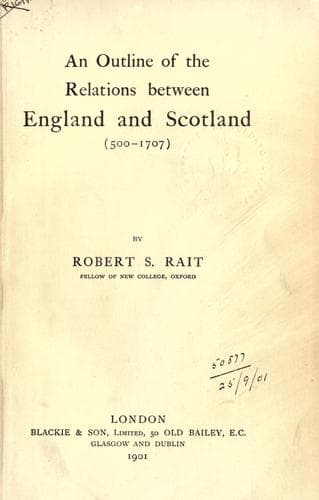
An Outline of the Relations between England and Scotland (500-1707)Rait, Robert S. (Robert Sangster)
History
An Outline of the Relations between England and Scotland (500-1707)
Rait, Robert S. (Robert Sangster)
England -- Foreign relations -- Scotland; Scotland -- Foreign relations -- England
Henry of England, and, in 1251, married Margaret, Henry's eldest
daughter. The relations of Alexander to Henry III and to Edward I will
be narrated in the following chapter. Not once throughout his reign was
any blood spilt in an English quarrel, and the story of his reign forms
no part of our subject. Its most interesting event is the battle of
Largs. The Scottish kings had, for some time, been attempting to annex
the islands, and, in 1263, Hakon of Norway invaded Scotland as a
retributive measure. He was defeated at the battle of Largs, and, in
1266, the Isles were annexed to the Scottish crown. The fact that this
forcible annexation took place, after a struggle, only twenty years
before the death of Alexander III, must be borne in mind in connection
with the part played by the Islanders in the War of Independence.
FOOTNOTES:
[Footnote 34: _Art of War in the Middle Ages_, p. 391.]
[Footnote 35: Cf. App. A.]
[Footnote 36: In the final order of battle, David seems to have
attempted to bring all classes of his subjects together, and the
divisions have a political as well as a military purpose. The right wing
contained Anglo-Norman knights and men from Strathclyde and Teviotdale,
the left wing men from Lothian and Highlanders from Argyll and the
islands, and King David's reserve was composed of more knights along
with men from Moray and the region north of the Forth.]
[Footnote 37: The Empress Maud, daughter of Henry I, and niece of David,
must be carefully distinguished from Queen Maud, wife of Stephen, and
cousin of David, who negotiated the Treaty of Durham.]
[Footnote 38: Ailred credits Bruce with a long speech, in which he tries
to convince David that his real friends are not his Scottish subjects,
but his Anglo-Norman favourites, and that, accordingly, he should keep
on good terms with the English.]
[Footnote 39: William's English earldom of Huntingdon, which had been
forfeited, was restored, in 1185, and was conferred by William upon his
brother, David, the ancestor of the claimants of 1290.]
[Footnote 40: As Alexander III was the last king of Scotland who ruled
before the War of Independence, it is interesting to note that he was
crowned at Scone with the ancient ceremonies, and as the representative
of the Celtic kings of Scotland. Fordun tells us that the coronation
took place on the sacred stone at Scone, on which all Scottish kings had
sat, and that a Highlander appeared and read Alexander's Celtic
genealogy (Annals XLVIII. Cf. App. A). There is no indication that
Alexander's subjects, from the Forth to the Moray Firth, were "stout
Northumbrian Englishmen", who had, for no good reason, drifted away from
their English countrymen, to unite them with whom Edward I waged his
Scottish wars.]
CHAPTER III
THE SCOTTISH POLICY OF EDWARD I
1286-1296
Public-domain text, read in full here on John Shaqi.
Reviews
Reviews
No reviews yet
Be the first to share your thoughts on this work.
Join the Discussion
Join the discussion
Sign in to leave a comment or review.
Sign InorCreate an account