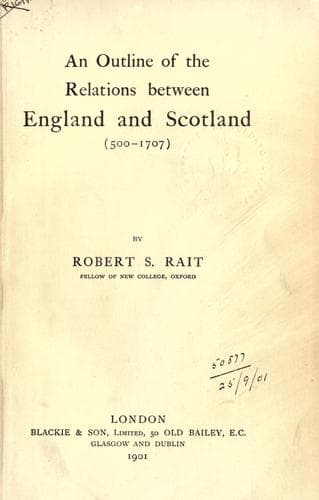
An Outline of the Relations between England and Scotland (500-1707)Rait, Robert S. (Robert Sangster)
History
An Outline of the Relations between England and Scotland (500-1707)
Rait, Robert S. (Robert Sangster)
England -- Foreign relations -- Scotland; Scotland -- Foreign relations -- England
Of the thirteen[43] competitors who put forward claims to the crown,
only three need be here mentioned. They were each descended from David,
Earl of Huntingdon, brother of William the Lion and grandson of David I.
The claimant who, according to the strict rules of primogeniture, had
the best right was John Balliol, the grandson of Margaret, the eldest
daughter of Earl David. His most formidable opponent was Robert Bruce of
Annandale, the son of Earl David's second daughter, Isabella, who based
his candidature on the fact that he was the grandson, whereas Balliol
was the great-grandson, of the Earl of Huntingdon, through whom both the
rivals claimed. The third, John Hastings, was the grandson of David's
youngest daughter, Ada. Bishop Fraser, in the letter to which we have
already referred, urged Edward I to interfere in favour of John Balliol,
who might be employed to further English interests in Scotland. The
English king thereupon decided to put forward a definite claim to be
lord paramount, and, in virtue of that right, to decide the disputed
succession.
Since Richard I had restored his independence to William the Lion, in
1189, the question of the overlordship had lain almost entirely dormant.
On John's succession, William had done homage "saving his own right",
but whether the homage was for Scotland or solely for his English fiefs
was not clear. His successor, Alexander II, aided Louis of France
against the infant Henry III, and, after the battle of Lincoln, came to
an agreement with the regent, by which he did homage to Henry III, but
only for the earldom of Huntingdon and his other possessions in Henry's
kingdom. After the fall of Hubert de Burgh, Henry used his influence
with Pope Gregory IX, who looked upon the English king as a valuable
ally in the great struggle with Frederick II, to persuade the pope to
order the King of Scots to acknowledge Henry as his overlord (1234).
Alexander refused to comply with the papal injunction, and the matter
was not definitely settled. Henry made no attempt to enforce his claim,
and merely came to an agreement with Alexander regarding the English
possessions of the Scottish king (1236). During the minority of
Alexander III, when Henry was, for two years, the real ruler of Scotland
(1255-1257), he described himself not as lord paramount, but as chief
adviser of the Scottish king. Lastly, when, in 1278, Alexander III took
a solemn oath of homage to Edward at Westminster, he, according to the
Scottish account of the affair, made an equally solemn avowal that to
God alone was his homage due for the kingdom of Scotland, and Edward had
accepted the homage thus rendered.
Public-domain text, read in full here on John Shaqi.
Reviews
Reviews
No reviews yet
Be the first to share your thoughts on this work.
Join the Discussion
Join the discussion
Sign in to leave a comment or review.
Sign InorCreate an account