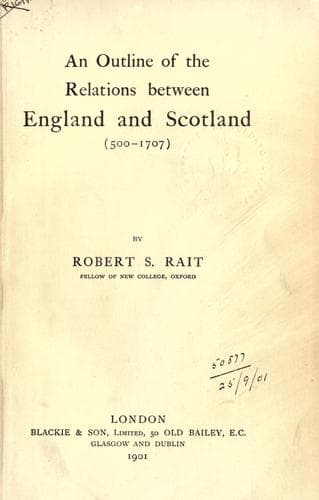
An Outline of the Relations between England and Scotland (500-1707) — John Shaqi
An Outline of the Relations between England and Scotland (500-1707)Rait, Robert S. (Robert Sangster)
History
An Outline of the Relations between England and Scotland (500-1707)
Rait, Robert S. (Robert Sangster)
England -- Foreign relations -- Scotland; Scotland -- Foreign relations -- England
The eagerness with which the Scots welcomed the proposal of marriage was
sufficient evidence that the time had come for carrying out Edward's
statesmanlike scheme, but the conditions which were annexed to it should
have warned him that there were limits to the Scottish compliance with
his wishes. Scotland was not in any way to be absorbed by England,
although the crowns would be united in the persons of Edward and
Margaret. Edward wisely made no attempt to force Scotland into any more
complete union, although he could not but expect that the union of the
crowns would prepare the way for a union of the kingdoms. He certainly
interpreted in the widest sense the rights given him by the treaty of
Brigham, but when the Scots objected to his demand that all Scottish
castles should be placed in his power, he gave way without rousing
further suspicion or indignation. Hitherto, his policy had been
characterized by the great sagacity which he had shown in his conduct of
English affairs; it is impossible to refuse either to sympathize with
his ideals or to admire the tact he displayed in his negotiations with
Scotland. His considerateness extended even to the little Maid of
Norway, for whose benefit he victualled, with raisins and other fruit,
the "large ship" which he sent to conduct her to England. But the large
ship returned to England with a message from King Eric that he would not
entrust his daughter to an English vessel. The patient Edward sent it
back again, and it was probably in it that the child set sail in
September, 1290. Some weeks later, Bishop Fraser of St. Andrews, one of
the guardians, and a supporter of the English interest, wrote to Edward
that he had heard a "sorrowful rumour" regarding the queen.[42] The
rumour proved to be well-founded; in circumstances which are unknown to
us, the poor girl-queen died on her voyage, and her death proved a fatal
blow to the work on which Edward had been engaged for the last four
years.
Public-domain text, read in full here on John Shaqi.
Reviews
Reviews
No reviews yet
Be the first to share your thoughts on this work.
Join the Discussion
Join the discussion
Sign in to leave a comment or review.
Sign InorCreate an account