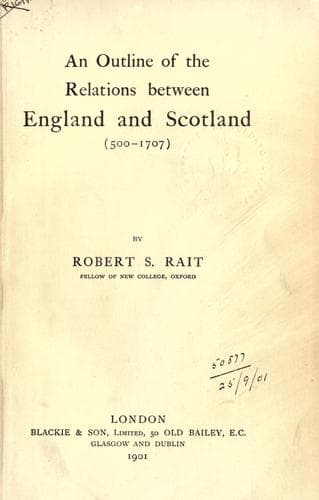
An Outline of the Relations between England and Scotland (500-1707)Rait, Robert S. (Robert Sangster)
History
An Outline of the Relations between England and Scotland (500-1707)
Rait, Robert S. (Robert Sangster)
England -- Foreign relations -- Scotland; Scotland -- Foreign relations -- England
It is not less pathetic to turn to Edward's scheme for the government of
Scotland. It bears the impress of a mind which was that of a statesman
and a lawyer as well as a soldier. It is impossible to deny a tribute of
admiration to its wisdom, or to question the probability of its success
in other circumstances. Had the course of events been more propitious
for Edward's great plan, Scotland and England might have been spared
much suffering. But Edward failed to realize that the Scots could no
longer regard him as the friend and ally to whose son they had willingly
agreed to marry their queen. He was now but a military conqueror in
temporary possession of their country, an enemy to be resisted by any
means. The new constitution was foredoomed to failure. Carrying out his
scheme of 1296, Edward created no vassal-king, but placed Scotland under
his own nephew, John of Brittany; he interfered as little as might be
with the customs and laws of the country; he placed over it eight
justiciars with sheriffs under them. In 1305, Edward's Parliament, which
met at London, was attended by Scottish representatives. The
incorporation of the country with its larger neighbour was complete, but
it involved as little change as was possible in the circumstances.
The Parliament of 1305 was attended by Robert Bruce, Earl of Carrick,
who attended not as a representative of Scotland, but as an English
lord. Bruce was the grandson of the Robert Bruce of Annandale who had
been promised the crown by Alexander II, and who had been one of the
claimants of 1290. His grandfather had done homage to Edward, and Bruce
himself had been generally on the English side, and had fought against
Wallace at Falkirk. When John Balliol had decided to rebel, he had
transferred the lands of Annandale from the Bruces to the Comyns, and
they had been restored by Edward I after Balliol's submission. From 1299
to 1303, Bruce had been associated with Comyn in the guardianship of the
kingdom, but, like Comyn, had submitted to Edward. Nobody in Scotland
could now think of a restoration of Balliol, and if there was to be a
Scottish king at all, it must obviously be either Comyn or Bruce. The
claim of John Comyn the younger was much stronger than that of his
father had been. The elder Comyn had claimed on account of his descent
from Donald Bane, the brother and successor of Malcolm Canmore; but the
younger Comyn had an additional claim in right of his mother, who was a
sister of John Balliol. Between Bruce and Comyn there was a
long-standing feud. In 1299, at a meeting of the Great Council of
Scotland at Peebles, Comyn had attacked Bruce, and they could only be
separated by the use of violence. On the 10th February, 1305-6, Bruce
and the Comyn met in the church of the convent of the Minorite Friars at
Dumfries. Tradition tells that they met to adjust their conflicting
claims, with a view to establishing the independence of the country in
Public-domain text, read in full here on John Shaqi.
Reviews
Reviews
No reviews yet
Be the first to share your thoughts on this work.
Join the Discussion
Join the discussion
Sign in to leave a comment or review.
Sign InorCreate an account