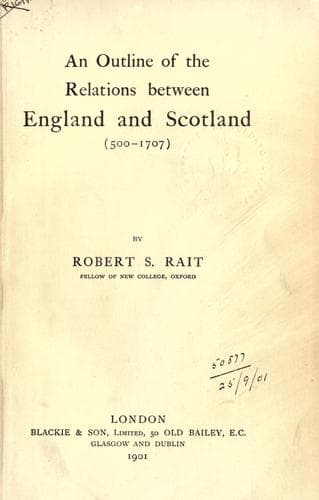
An Outline of the Relations between England and Scotland (500-1707)Rait, Robert S. (Robert Sangster)
History
An Outline of the Relations between England and Scotland (500-1707)
Rait, Robert S. (Robert Sangster)
England -- Foreign relations -- Scotland; Scotland -- Foreign relations -- England
the person of one or other of the rivals; that a dispute arose in which
they came to blows; and that Bruce, after inflicting a severe wound upon
his enemy, left the church. "I doubt I have slain the Red Comyn," he
said to his followers. "Doubt?" was the reply of Sir Roger Fitzpatrick,
"I'll mak siccar." The actual circumstances of the affair are unknown to
us; but Bruce may fairly be relieved of the suspicion of any
premeditation, because it is most unlikely that he would have needlessly
chosen to offend the Church by committing a murder within sanctuary. The
real interest attaching to the circumstances lies in the tradition that
the object of the meeting was to organize a resistance against Edward I.
Whether this was so or not, there can be no doubt that the result of the
conference compelled the Bruce to place himself at the head of the
national cause. A Norman baron, born in England, he was by no means the
natural leader for whose appearance men looked, and there was a grave
chance of his failing to arouse the national sentiment. But the murder
of one claimant to the Scottish throne at the hands of the only other
possible candidate, who thus placed himself in the position of undoubted
heir, could scarcely have been forgiven by Edward I, even if the Comyn
had not, for the past two years, proved a faithful servant of the
English king. There was no alternative, and, on the 27th March, 1306,
Robert, Earl of Carrick and Lord of Annandale, was crowned King of the
Scots at Scone. The ancient royal crown of the Scottish kings had been
removed by Balliol in 1296, and had fallen into the hands of Edward, but
the Countess of Buchan placed on the Bruce's head a hastily made coronet
of gold.
It was far from an auspicious beginning. It is difficult to give Bruce
credit for much patriotic feeling, although, as we have seen, he had
been one of the guardians who had maintained a semblance of
independence. The death of the Comyn had thrown against him the whole
influence of the Church; he was excommunicate, and it was no sin to slay
him. The powerful family, whose head had been cut off by his hand, had
vowed revenge, and its great influence was on the side of the English.
It is no small tribute to the force of the sentiment of nationality that
the Scots rallied round such a leader, and it must be remembered that,
from whatever reason the Bruce adopted the national cause, he proved in
every respect worthy of a great occasion, and as time passed, he came to
deserve the place he occupies as the hero of the epic of a nation's
freedom.
Public-domain text, read in full here on John Shaqi.
Reviews
Reviews
No reviews yet
Be the first to share your thoughts on this work.
Join the Discussion
Join the discussion
Sign in to leave a comment or review.
Sign InorCreate an account