Analysis of the Phenomena of the Human MindMill, James
PhilosophyPhilosophy
Analysis of the Phenomena of the Human Mind
Mill, James
Psychology
Produced by Ed Brandon
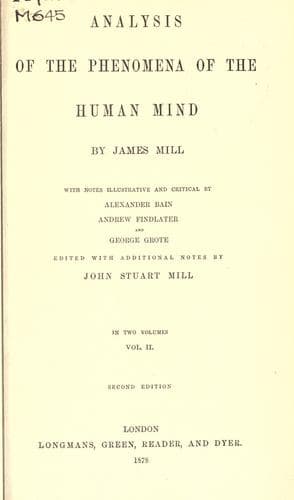
ANALYSIS
OF THE PHENOMENA OF THE
HUMAN MIND
BY JAMES MILL
WITH NOTES ILLUSTRATIVE AND CRITICAL BY
ALEXANDER BAIN
ANDREW FINDLATER
AND
GEORGE GROTE
EDITED WITH ADDITIONAL NOTES BY
JOHN STUART MILL
IN TWO VOLUMES
VOL. I.
SECOND EDITION
LONDON
LONGMANS, GREEN, READER, AND DYER.
1878
"In order to prepare the way for a just and comprehensive system of
Logic, a previous survey of our nature, considered as a great whole,
is an indispensable requisite."--_Philosophical Essays_ (_Prelim.
Dissert._) p. lxvii. _by Dugald Stewart, Esq._
"Would not Education be necessarily rendered more systematical and
enlightened, if the powers and faculties on which it operates were
more scientifically examined, and better understood?" _Ibid._ p.
xlviii.
[_Right of Translation reserved._]
PREFACE
TO
THE PRESENT EDITION.
IN the study of Nature, either mental or physical, the aim of the
scientific enquirer is to diminish as much as possible the catalogue
of ultimate truths. When, without doing violence to facts, he is
able to bring one phenomenon within the laws of another; when he can
shew that a fact or agency, which seemed to be original and
distinct, could have been produced by other known facts and
agencies, acting according to their own laws; the enquirer who has
arrived at this result, considers himself to have made an important
advance in the knowledge of nature, and to have brought science, in
that department, a step nearer to perfection. Other accessions to
science, however important practically, are, in a scientific point
of view, mere additions to the materials: this is something done
towards perfecting the structure itself.
Public-domain text, read in full here on John Shaqi.
Reviews
Reviews
No reviews yet
Be the first to share your thoughts on this work.
Join the Discussion
Join the discussion
Sign in to leave a comment or review.
Sign InorCreate an account