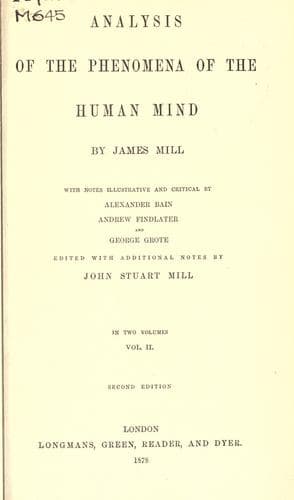
Analysis of the Phenomena of the Human MindMill, James
PhilosophyPhilosophy
Analysis of the Phenomena of the Human Mind
Mill, James
Psychology
The subordinate class is distinguished from they rest of the greater
class by some peculiarity, something in which the individuals of it
agree with one another, and do not agree with the rest. Thus to
recur to the example of sound. One set of sounds affect me in a
certain way, a way peculiar to that set. Wishing to distinguish
these sounds from others by a mark, I call them _loud_. Another set
of sounds affect me in another way, and I call them _low_; a third
set in another way, and I call them _harsh_; a fourth in another
way, and I call them _sweet_. By means of those adjectives applied
as marks upon the mark of the great class, I have the names of four
species, or sub-classes; 1, loud sounds; 2, low sounds; 3, harsh
sounds; 4, {146} sweet sounds; and the number might be greatly
enlarged.
It thus appears that, as nouns substantive are marks of ideas, or
sensations, nouns adjective are marks put upon nouns substantive, or
marks upon marks; in order to limit the signification of the noun
substantive; and instead of its marking a large class, to make it
mark a subdivision of that class. Thus the word, rose, is the mark
of a large class: apply to it the adjective _yellow_, that is, put
the mark yellow upon the mark rose, and you have the name, yellow
rose, which is a sub-division, or species, of the class Rose.
This peculiarity of naming, this putting of marks upon marks, in
order to modify the meaning of a certain mark, is a contrivance
which deserves the greatest attention. It is one of the principal
expedients for the great purpose of economizing names, and
performing the business of marking with the smallest number of
marks; but, like the rest of the contrivances for this purpose, it
contributes to obscure the simple process of naming; and when not
distinctly known and attended to, operates as a source of confusion
and error.
The use of adjectives, in economizing names, is most conspicuous, in
the case of those subdivisions which apply to the greatest number of
classes. There is one distinction which applies to most classes; the
distinction between what pleases, and what does not please us, no
matter on what account. The first we call good, the second evil.
These two terms serve to mark a very great number of subordinate
classes, and, of course, save, to a great extent, the multiplication
of names.
Public-domain text, read in full here on John Shaqi.
Reviews
Reviews
No reviews yet
Be the first to share your thoughts on this work.
Elsewhere in the archive
Join the Discussion
Join the discussion
Sign in to leave a comment or review.
Sign InorCreate an account