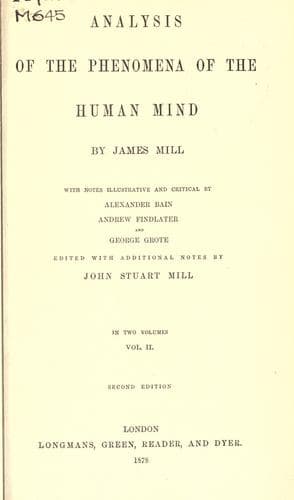
Analysis of the Phenomena of the Human MindMill, James
PhilosophyPhilosophy
Analysis of the Phenomena of the Human Mind
Mill, James
Psychology
{147} Thus, in the case of the senses, we have the word taste, the
mark of one great class of sensations. Tastes we divide into
sub-classes by the words good and evil; good tastes being one class,
bad tastes another. If we had invented separate marks for each of
these two classes, we should have had three names, to mark the class
taste with these its two primary subdivisions; and we should have
had occasion for the same number of names in the case of each of the
five senses; or, fifteen different names. But the adjectives, good,
and evil, they being applicable to all the senses, save us the
invention of names for the sub-classes of the other four senses; as
we say good smells, bad smells, in the same manner as good tastes,
and bad tastes. They save, therefore, eight names out of fifteen, or
more than one-half.
The economizing power of adjectives is still more remarkable, when
we depart from simple sensations and ideas, and apply them as marks
upon the names of the complex, which are far more numerous. Thus,
the term horse is the mark of a complex idea, and the name of a
class of objects. We say good horse and bad horse, good dog and bad
dog, good house and bad house, and so in cases without number; in
each of which, the repetition of the two adjectives, good, and bad,
saves us the use and embarrassment of separate names.
It deserves to be remarked, that the terms good and evil apply much
more generally to that class of complex ideas, in the formation of
which the mind has but little control; namely, those of external
objects; than they do to the other class of complex ideas which the
mind makes up in an arbitrary {148} manner to suit its own
convenience. Ideas of the latter description are very often made up
according to the distinction of good and evil. Thus, the idea glory,
is composed of ingredients all of which belong to the classes, good;
and the idea good, is multifariously included in the name. After the
same manner, the idea of evil is multifariously included in the
complex idea disgrace. Good is implied in the term virtue, evil in
the term vice; good is implied in the term wealth, evil in the term
poverty; good is implied in the term power, evil in the term
weakness. In some cases, the ideas of this class are so general,
that good and evil are both included; and, in such cases, adjectives
are necessary to mark the subdivisions or species. Thus, we say good
manners, bad manners; good sense, bad sense; good conduct, bad
conduct; and so on.
Public-domain text, read in full here on John Shaqi.
Reviews
Reviews
No reviews yet
Be the first to share your thoughts on this work.
Elsewhere in the archive
Join the Discussion
Join the discussion
Sign in to leave a comment or review.
Sign InorCreate an account