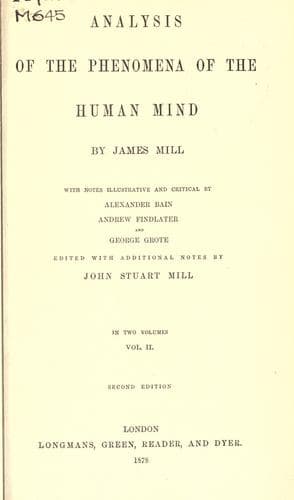
Analysis of the Phenomena of the Human MindMill, James
PhilosophyPhilosophy
Analysis of the Phenomena of the Human Mind
Mill, James
Psychology
Next to the adjectives which form the numerous sub-classes of good
and evil, those which mark degrees are of the most extensive
application, and in the operation of sub-marking save the greatest
number of names. Thus the terms, great, and little, are applicable
to a great proportion of the marks of complex ideas of both
formations. We say a great tree, a little tree; a great man, a
little man; a great crime, a small crime; great blame, little blame;
great honour, little honour; great value, little value; great
weight, little weight; great strength, little strength, and so on.
Different adjectives differ in the number of classes to the
subdivision of which they are subservient. Thus hot and cold are
only applicable where diversities of temperature are included;
round, square, and {149} so on, where figure is included; white or
black, where colour; and so on.
Beside the use of adjectives, in dividing great classes into smaller
ones, without multiplication of names; they sometimes answer another
purpose. It often happens that, in the cluster of sensations or
ideas which have one name; we have occasion to call attention
particularly to some one ingredient of the cluster. Adjectives render
this service, as well as that of marking a class. This rose, I say,
is red; that rose is yellow: this stone is hot, that stone is cold.
The term, red rose, or yellow rose, is the name of a class. But when
I say, this rose is red, where an individual is named, I mark
emphatically the specific difference; namely, red, or yellow; which
constitutes that subdivision of the genus rose, to which the
individual belongs.[45]
[Editor's footnote 45: In the concluding paragraph we find the first
recognition by the author that class names serve any purpose, or are
introduced for any reason, except to save multiplication of names.
Adjectives, it is here said, answer also the purpose of calling
attention to some one ingredient of the cluster of sensations
combined under one name. That is to say, they enable us to affirm
that the cluster contains that ingredient: for they do not merely
call attention to the ingredient, or remind the hearer of it: the
hearer, very often, did not know that the cluster contained
the ingredient, until he was apprised by the proposition.
Public-domain text, read in full here on John Shaqi.
Reviews
Reviews
No reviews yet
Be the first to share your thoughts on this work.
Elsewhere in the archive
Join the Discussion
Join the discussion
Sign in to leave a comment or review.
Sign InorCreate an account