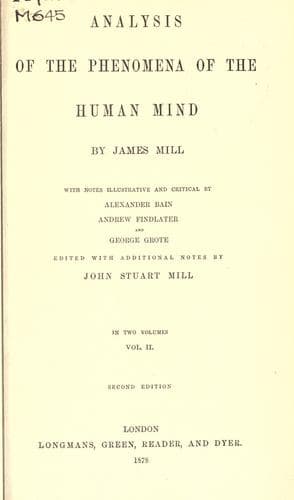
Analysis of the Phenomena of the Human MindMill, James
PhilosophyPhilosophy
Analysis of the Phenomena of the Human Mind
Mill, James
Psychology
But surely it is not only adjectives which fulfil either office,
whether of giving information of an ingredient, or merely fixing the
attention upon it. All general names do so, when used as predicates.
When I say that a distant object which I am pointing at is a tree,
or a building, I just as much call attention to certain ingredients
in the cluster of sensations constituting the object, as I do when I
say, This rose is red. So {150} far is it from being true that
adjectives are distinguished from substantives by having this
function in addition to that of economizing names, that it is, on
the contrary, much more nearly true of adjectives than of the
class-names which are nouns substantive, that the economizing of
names is the principal motive for their institution. For though
general names of some sort are indispensable to predication,
adjectives are not. As is well shewn in the text, the peculiarity,
which really distinguishes adjectives from other general names, is
that they mark cross divisions. All nature having first been marked
out into classes by means of nouns substantive, we might go on by
the same means subdividing each class. We might call the large
individuals of a class by one noun substantive and the small ones by
another, and these substantives would serve all purposes of
predication; but to do this we should need just twice as many
additional nouns substantive as there are classes of objects. Since,
however, the distinction of large and small applies to all classes
alike, one pair of names will suffice to designate it. Instead
therefore of dividing every class into sub-classes, each with its
own name, we draw a line across all the classes, dividing all nature
into large things and small, and by using these two words as
adjectives, that is, by adding one or other of them as the occasion
requires to every noun substantive which is the name of a class, we
are able to mark universally the distinction of large and small by
two names only, instead of many millions.--_Ed._]
{151} SECTION III.
VERBS.
1. There is one class of complex ideas, of so particular a nature,
and of which we have so frequent occasion to speak, that the means
of sub-dividing them require additional contrivances. Marks put upon
marks are still the instrument. But the instrument, to render it
more effectual to this particular purpose, is fashioned in a
particular way. I allude to the class of words denominated Verbs:
which are, in their essence, adjectives, and applied as marks upon
marks; but receive a particular form, in order to render them, at
the same time, subservient to other purposes.
The mode of their marking, and the peculiarity of their marking
power may easily, I hope, be thus conceived.
Public-domain text, read in full here on John Shaqi.
Reviews
Reviews
No reviews yet
Be the first to share your thoughts on this work.
Elsewhere in the archive
Join the Discussion
Join the discussion
Sign in to leave a comment or review.
Sign InorCreate an account