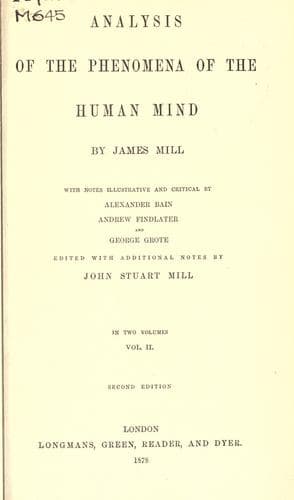
Analysis of the Phenomena of the Human MindMill, James
PhilosophyPhilosophy
Analysis of the Phenomena of the Human Mind
Mill, James
Psychology
Adjectives of profit or disprofit, need prepositions to mark their
connexion with the things benefited or hurt; as, hurtful to the
crop; good for the health. These adjectives afford a good example of
the manner in which generical adjectives are divided into numerous
sub-species, without the inconvenience of new names, by the aid of
the prepositions: thus, hurtful, which notes all kinds of
hurtfulness, is made to note {206} its various species, in the
following manner: hurtful to the health, hurtful to the eyes,
hurtful to the stomach, hurtful to the crops, hurtful to the
reputation: all different species of hurtfulness, which might be
noted by adjectives severally appropriated to them.
There is nothing particular to be remarked of the manner in which
adjectives of plenty, or want, or those signifying an affection of
the mind, are connected with the objects they connote, by
prepositions; we shall, therefore, proceed to shew the manner in
which verbs are connected with substantives, by their means.
3. All verbs are adjectives, either active or passive, put into a
particular form, for the sake of a particular connotation. All
actions, saving those which begin and end in the actor, have a
reference to a patient, or something acted on; and the being acted
on; the passion as it is called; has a reference to the actor.
Action, therefore, and passion, are relative terms, standing in the
order of cause and effect; agent and patient, are the names of the
subjects of the action and the passion, the cause and the effect.
Most actions are motions, or named by analogy to motions. In
applying terms denoting motion, there is particular occasion for
marking the two points of termination; the point at which it began,
and the point at which it ended. This is effected by the name of the
two places, and a preposition. The contrivance will be sufficiently
illustrated by an obvious example: "John travelled from London to
Dover:" "Travelled," the name of the motion; London, the point of
commencement; Dover, the point of termination: from, a word denoting
commencement, {207} connecting London with travelled; to, a word
signifying completion, connecting the word Dover, with the word
travelled.
Some verbs, which imply motion, have their main, or only reference,
to the point of its termination. Thus, he stopped at Dover: he
struck him on the head: he stabbed him in the side. These
prepositions, whatever their precise import, which we shall not now
stop to inquire, mark, when thus applied to the name of the place at
which the respective motions terminated, the connexion of the two
names, that of the motion, and that of its point of termination.
Public-domain text, read in full here on John Shaqi.
Reviews
Reviews
No reviews yet
Be the first to share your thoughts on this work.
Elsewhere in the archive
Join the Discussion
Join the discussion
Sign in to leave a comment or review.
Sign InorCreate an account