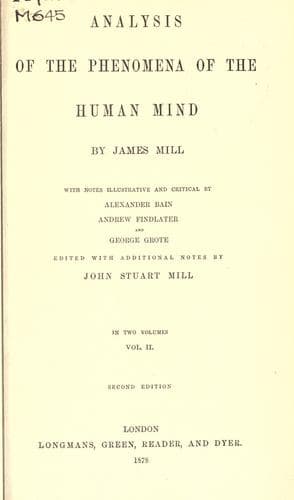
Analysis of the Phenomena of the Human MindMill, James
PhilosophyPhilosophy
Analysis of the Phenomena of the Human Mind
Mill, James
Psychology
Our object, however, on the present occasion, is distinct, both from
that of the grammarian, and that of the etymologist. We have shewn,
that a set of marks are exceedingly useful to connect single words,
and by what contrivances this end is accomplished; it remains for us
to shew, what use there is of marks {214} to connect Predications;
and by what contrivances that object is attained.
The occasions for the use of marks to connect Predications, seem to
be of two kinds.
First, When two Predications are to be marked, as following one
another.
Secondly, When they are to be marked, as modified, the one by the
other.
1. Those of the first kind need but few words for their explanation.
I may say, "Newton was a mathematician," "Locke was a
metaphysician," "Milton was a poet." So stated, these Predications
do not mark any particular order in my thoughts. I desire, however,
to show, that the ideas thereby expressed, were proximate parts of
the train in my mind. The word _and_, which means _add_, placed
between every pair, affords the requisite indication.
Like _and_, the conjunction _nor_ marks predications in sequence. It
differs from _and_ only in uniting negative predications. "The act
is not honourable, _nor_ is the man honest." In this case, it is
obvious that _nor_, whatever its origin, has the meaning of _and
not_. The predications then are two negative predications, the
sequence of which, is marked by the word _and_.
_But_, though it has been otherwise classed, and called adversative,
is of the same kind, and simply marks the sequence. Thus we say,
"Catiline was a brave man, but Catiline was a wicked man." The
meaning of _but_ is scarcely different from that of _and_, addition
being the fundamental idea signified by both of them. The
_opposition_ between the two predications is signified by the
predications themselves, not by the {215} connective.[63] In fact,
the sense would not be changed, if we substituted _and_ for _but_.
It is only because, in use, _but_ has been commonly confined to the
sequence of two _opposing_ predications, that the word _but_ is no
sooner expressed, than an _opposing_ predication is anticipated.
This is a simple case of association.
[Findlater's footnote 63: This is not strictly correct. _But_ is
compounded of the two prepositions or local particles _by_ and _out_
(Ang. Sax. _bi utan_); and the force of it, in the example given in
the text, may be thus paraphrased: "Catiline was a brave man; _but_
(_by_, near or beside that fact, put another fact, which is _out_,
away, or different from it, namely) Catiline was a wicked man." This
is something more than a simple case of association; the opposition
is expressed as well as the addition.--_F._]
2. It is not necessary for us to do more than exemplify the
principal cases in which one Predication is modified by another.
"The space is triangular, _if_ it is bounded by three straight
lines."
Public-domain text, read in full here on John Shaqi.
Reviews
Reviews
No reviews yet
Be the first to share your thoughts on this work.
Elsewhere in the archive
Join the Discussion
Join the discussion
Sign in to leave a comment or review.
Sign InorCreate an account