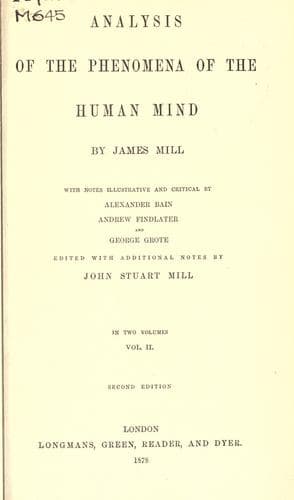
Analysis of the Phenomena of the Human MindMill, James
PhilosophyPhilosophy
Analysis of the Phenomena of the Human Mind
Mill, James
Psychology
We proceed afterwards to some clear and good additional remarks--p.
298. A class-term, as _black_, "is associated with two
distinguishable things, but with the one much more than with the
other: the clusters, with which it is associated, are variable: the
peculiar sensation with which it is associated, is invariable. It is
constantly, and therefore much more strongly, associated with the
sensation, than with any of the clusters. It is at once a name of
the clusters and a name of the sensation: but it is more peculiarly
a name of the sensation." Again shortly afterwards, the abstract
term is justly described as "marking exclusively one part (of the
cluster), upon which such and such effects depend, no alteration
being supposed in any other part of it."[p]
[Footnote p: The abstract term is coined for the express purpose of
marking one part of a cluster simultaneously present to the mind,
and fixing attention upon it without the other parts--but the
concrete term is often made to serve the same purpose, by means of
the adverb quatenus, [Greek: ka/thoson, ê(=|] &c. These phrases are
frequent both in Plato and Aristotle: the stock of abstract terms
was in their day comparatively small. It is needless to multiply
illustrations of that which pervades the compositions of both: a
very good one appears in Plato, Republ. I., p. 340 D, 341 C, 342.]
This process of marking exclusively, and attending to, one constant
portion of a complex state of consciousness, amidst a {286} great
variety of variable adjuncts--is doubtless one fundamental
characteristic in Abstraction and Classification. A mystery was
spread around it by Plato--first through his ascribing to the
Constant a separate self-existence, apart from the Variables--still
more by his hyperbolical predicates respecting these self-existent
transcendental Entia. Plato[q] however in other passages gives many
just opinions, respecting Classification, which are no way founded
on Realism, and are equally admissible by Nominalists: and portions
of Aristotle may be indicated, which describe the process of
abstraction as clearly as any thing in Hobbes or Berkeley.[r]
Public-domain text, read in full here on John Shaqi.
Reviews
Reviews
No reviews yet
Be the first to share your thoughts on this work.
Elsewhere in the archive
Join the Discussion
Join the discussion
Sign in to leave a comment or review.
Sign InorCreate an account