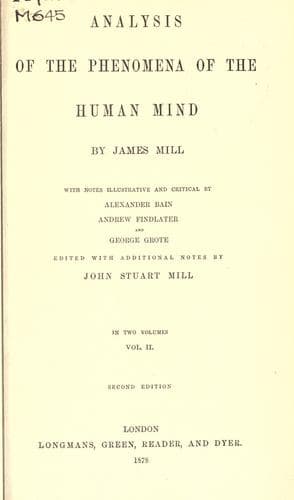
Analysis of the Phenomena of the Human MindMill, James
PhilosophyPhilosophy
Analysis of the Phenomena of the Human Mind
Mill, James
Psychology
[Footnote q: The two Platonic dialogues, Sophistes and Politikus,
(in which processes of Classification are worked out,) give
precepts, for correct and pertinent classification, not necessarily
involving the theory of Realism, but rather putting it out of sight;
though in one special part of the Sophistes, the debate is made to
turn upon it. The main purpose of Plato is to fix upon some fact or
phenomenon, clear and appropriate, as the groundwork for
distinguishing each class or sub-class--and to define thereby each
class-term (_i.e._, to determine its _connotation_, in the sense of
Mr. John Stuart Mill). Plato deprecates the mere following out of
resemblances as a most slippery proceeding ([Greek: o)listhêro/taton
ge/nos]--Sophist. 231 A). The commonly received classes carry with
them in his opinion, no real knowledge, but only the false
persuasion of knowledge: he wants to break them up and remodel
them.]
[Footnote r: See especially Aristot. De Memoriâ et Reminiscentiâ, c.
1, p. 449, b. 13. De Sensu et Sensili, c. 6, p. 445, b. 17. De Animâ
III. 8, p. 432, a. 9.]
One farther remark may be made upon these two Chapters of the
Analysis. Mr. James Mill seems to take little or no thought of
Classification and Abstraction, except as performed by Adjectives.
But the adjective presupposes a substantive, which is alike an
appellative; and which has already performed its duty in the way of
abstracting and classifying. This fact seems to be overlooked in the
language of some sentences in the present Chapter: for
example--"Some successions are found to depend upon the clusters
called _objects_, all taken together. Thus a tree, a man, a stone,
are the {287} antecedents of certain consequents, as such: and not
on account of any particular part of the cluster. Other consequents
depend not upon the whole cluster, but upon some particular part:
thus a tall tree produces certain effects which a tree not tall
cannot produce," &c.
Public-domain text, read in full here on John Shaqi.
Reviews
Reviews
No reviews yet
Be the first to share your thoughts on this work.
Elsewhere in the archive
Join the Discussion
Join the discussion
Sign in to leave a comment or review.
Sign InorCreate an account