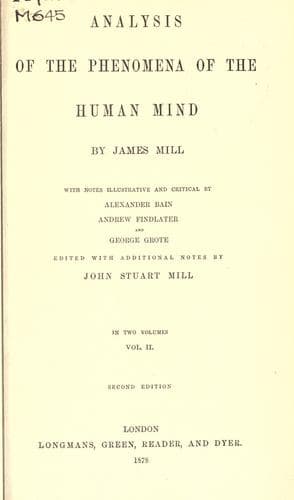
Analysis of the Phenomena of the Human MindMill, James
PhilosophyPhilosophy
Analysis of the Phenomena of the Human Mind
Mill, James
Psychology
I think that the phraseology of this passage is not quite clear.
"The whole cluster all taken together" is not a tree as such--a man
as such--a stone as such--but this particular man, tree, or stone,
as it stands: John, Thomas, Caius or Titius, clothed with all his
predicates, acting or suffering in some given manner. When we speak
of a man _as such_ or _quatenus man_--we do not include the whole
cluster, but only those attributes _connoted_ (in Mr. John Stuart
Mill's sense of the word) by the name _man_: we speak of him as a
member of the class _Man_. What I wish to point out is--That Man is
a class-term, just as much as _tall_ or _short_: only it is the
name of a larger class, while tall man is a smaller class under it.
The school-logicians did not consider substantives as connotative,
but only adjectives: Mr. James Mill has followed them as to this
extent of the word, though he has inverted their meaning of it (see
p. 299). Mr. John Stuart Mill, while declining to adopt the same
inversion, has enlarged the meaning of the word _connotative_, so as
to include appellative substantives as well as adjectives.--_G._]
[Editor's footnote 80: Rejecting the notion that classes and
classification would not have existed but for the necessity of
economizing names, we may say that objects are formed into classes
on account of their resemblance. It is natural to think of like
objects together; which is, indeed, one of the two fundamental laws
of association. But the resembling objects which are spontaneously
thought of together, are those which resemble each other obviously,
in their superficial aspect. These are the only classes which we
should form unpremeditatedly, and without the use of expedients. But
there are other resemblances which are not superficially obvious;
and many are not brought to light except by long experience, or
observation carefully directed to the purpose; being mostly
resemblances in the {288} manner in which the objects act on, or are
acted on by, other things. These more recondite resemblances are
often those which are of greatest importance to our interests. It is
important to us that we should think of those things together, which
agree in any particular that materially concerns us. For this
purpose, besides the classes which form themselves in our minds
spontaneously by the general law of association, we form other
classes artificially, that is, we take pains to associate mentally
together things which we wish to think of together, but which are
not sufficiently associated by the spontaneous action of association
by resemblance. The grand instrument we employ in forming these
artificial associations, is general names. We give a common name to
all the objects, we associate each of the objects with the name, and
by their common association with the name they are knit together in
close association with one another.
Public-domain text, read in full here on John Shaqi.
Reviews
Reviews
No reviews yet
Be the first to share your thoughts on this work.
Elsewhere in the archive
Join the Discussion
Join the discussion
Sign in to leave a comment or review.
Sign InorCreate an account